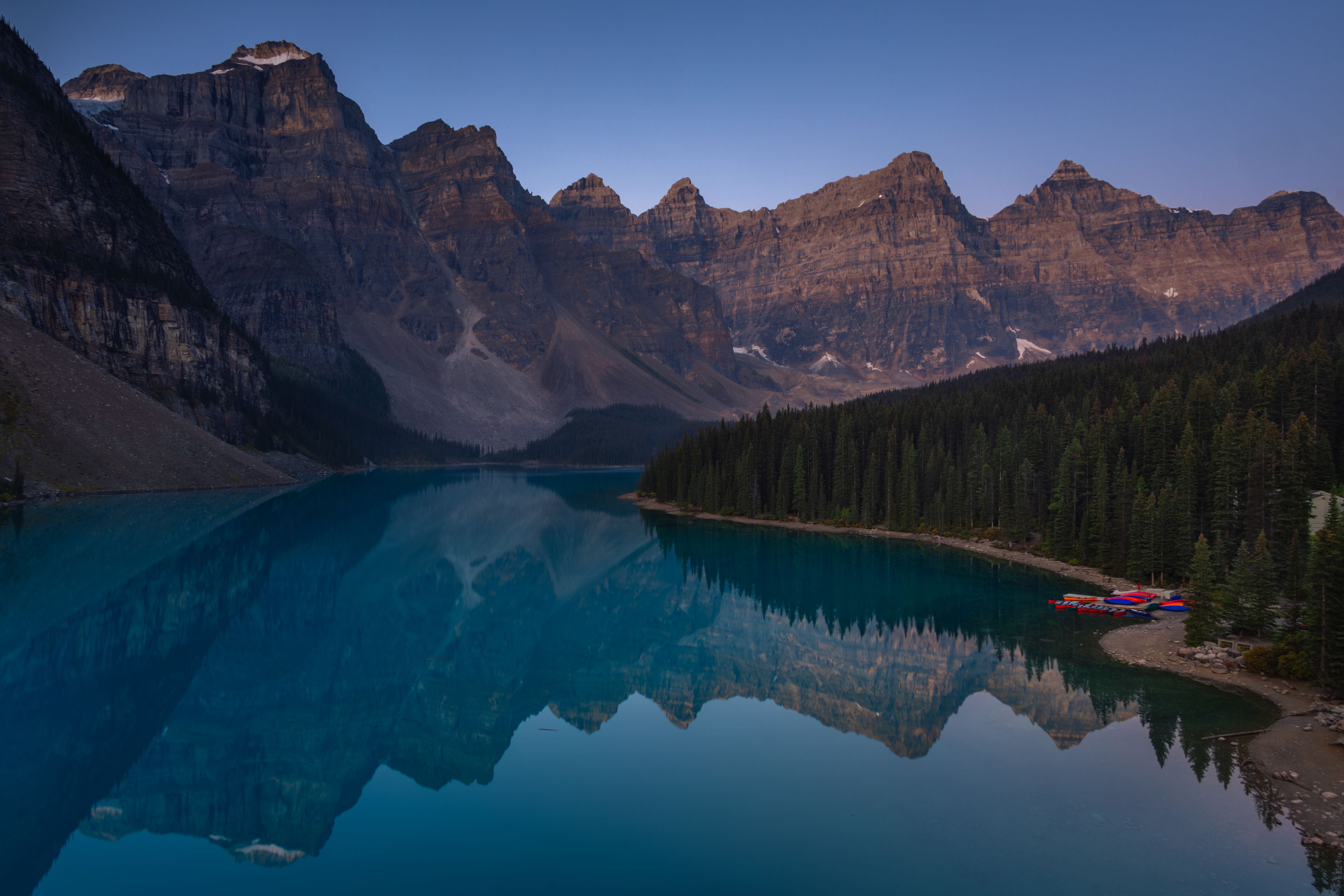
Lake Louise Sunrise
When the first frost holds the surface still enough to listen.
Lake Louise sits under big, glacial walls, but it’s the quiet that stays with you.
Unlike most alpine lakes, it shifts mood by the minute—wind, light, and temperature rewrite it fast.
In early fall, it offers a rare kind of clarity: a morning that feels unhurried, almost private.
The Boardwalk Before the Hotel Lights Fade
Most visitors arrive when the lake has already become an event—oars knocking, voices carrying, phones held up like small mirrors. But September mornings can still belong to the hour before that, when the shoreline is colder than you expect and the air has a clean, mineral edge. Walk the lakeside path near the Fairmont side and pay attention to the lamps and windows behind you. If there’s been a light frost overnight, the surface tightens and the lake starts behaving like glass, not water. For a few minutes, the hotel’s warm squares and walkway lights sit inside the reflection with the mountains, making two different worlds share one frame. People miss this because they face straight toward Victoria Glacier and wait for color. Turn slightly; let the human light sit at the edge of the alpine scene. It’s quieter, and it makes the place feel lived-in rather than staged.
The First Ten Minutes When Frost Releases the Shoreline
The transformation happens right as the lake stops being night and hasn’t yet become day—around the first thin lift of light behind the peaks, when the temperature is at its lowest and the water is most disciplined. In September, that’s often between 6:45 and 7:30 a.m., depending on the week. You’ll feel it more than you’ll see it at first: a hush in the trees, a brittle crunch from the path, your breath suddenly visible. The surface looks sealed, held in place by cold, and the reflections sharpen as if the lake is focusing. Then the sun finds the upper rock faces, not the water. The peaks brighten while the lake stays dim and turquoise beneath, creating a brief split-screen of warm stone and cool glacier. The moment ends when the first breeze arrives—sometimes from nowhere—and the mirror breaks into small, traveling ripples. If you’re waiting for dramatic color on the water, you’ll miss the subtler shift: the lake going from mirror to moving.
The Reflections
On a frosty September dawn, Mount Victoria and the dark tree line can appear duplicated with hard edges, like a clean fold in paper. The reflection holds longest near the shore before the center starts to tremble with the first breath of wind.
The Water
The water reads as milky turquoise with a faint jade cast, caused by suspended glacial silt (rock flour) from Victoria Glacier. At sunrise, it can look cooler and deeper because the surrounding light is still blue and the sun hasn’t reached the surface.
The Landscape
Steep peaks and the glacier sit close enough to feel immediate, while the forested edges soften the lower frame into silence. Early fall often brings a thin veil of cold air near the surface—less mist than a pale, hovering chill.
Best Angles
Right-side shoreline path near Fairmont Chateau Lake Louise
Stand on the boardwalk/edge path facing west-southwest; frame the hotel lights behind you as a subtle reflection alongside Mount Victoria.
Canoe dock area (before rentals begin)
Face straight up-lake toward Victoria Glacier; keep the dock low in frame to give the reflection a clean, uninterrupted foreground.
Left shoreline near the start of the Lake Agnes trail
Shift your frame to include more trees and less sky; the darker edge makes the turquoise feel denser and the morning quieter.
A bench or still point along the lakeside path, away from the dock
Sit facing slightly off-center from the glacier and watch the first ripples arrive; it’s the moment the lake stops posing and starts breathing.
Crowd pattern — Sunrise is the quietest window; by mid-morning the shoreline becomes steady with tour groups and photo stops, and the dock area turns lively once canoes begin.
Effort level — Minimal walking on paved/packed paths, but expect cold fingers and a still, standing kind of patience if you want the glassy surface.
Access note — Banff National Park entry pass is required; seasonal parking restrictions and shuttle requirements can apply, especially during peak periods.
What to bring — A warm layer and gloves for frost, a thermos, and something to sit on if you plan to wait; a microfiber cloth helps with lens condensation in cold air.
Handpicked Stays & Tables
Places chosen for beauty and intention, not algorithms. Each one is worth your time.

Fairmont Chateau Lake Louise
On the lakeshore

Post Hotel & Spa
Village of Lake Louise

Fairview Bar & Restaurant
Fairmont Chateau Lake Louise

Bill Peyto’s Cafe
Village of Lake Louise
In September, Lake Louise is most itself before anyone proves they were there.