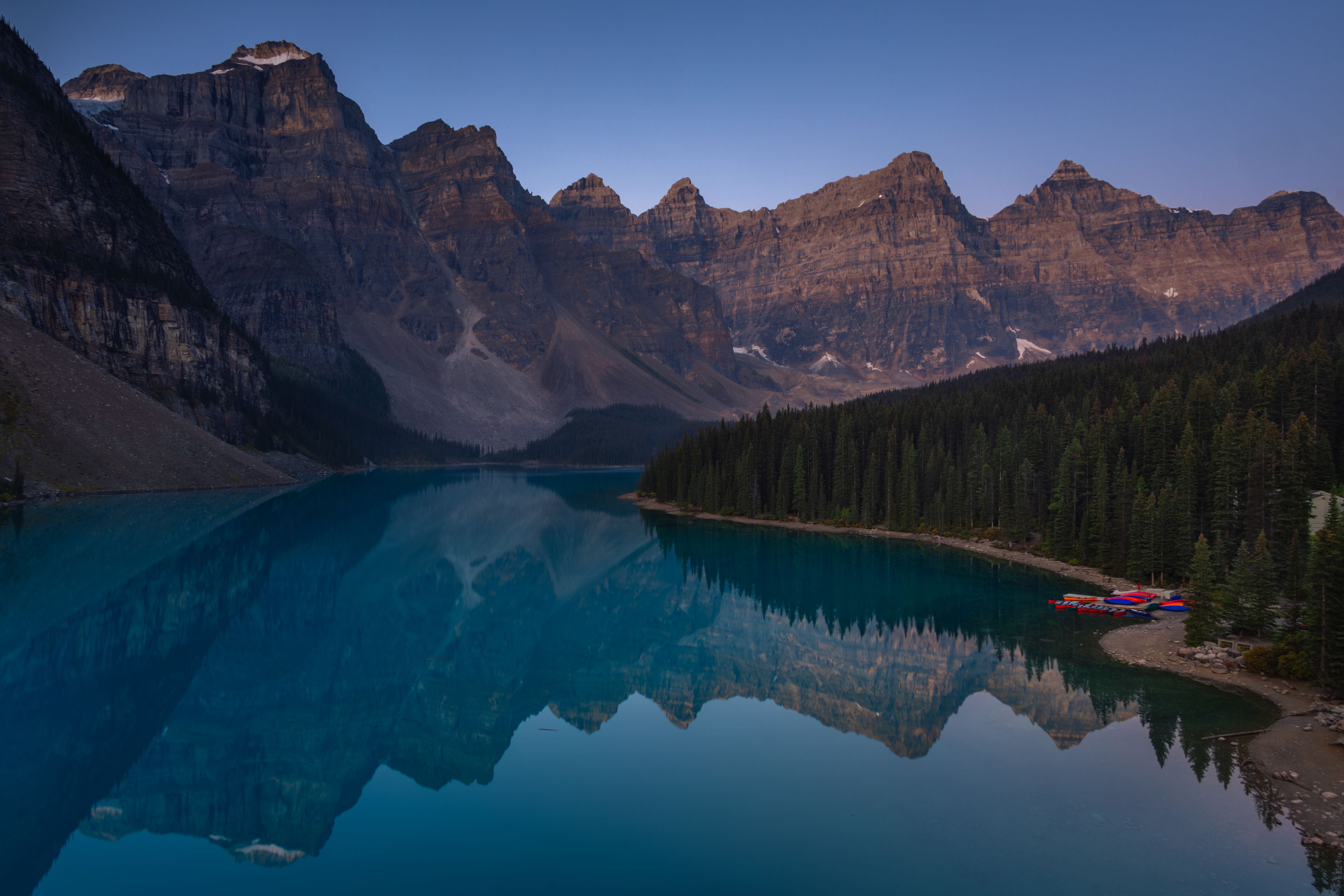
Lake Louise Sunrise
Where dawn reaches the water after the last footstep.
Lake Louise is familiar in photographs, but quieter in person—if you arrive before it wakes.
Its scale isn’t the surprise; it’s how quickly the surface changes from glass to texture once people and wind arrive.
At the far end, when the path thins out, the lake stops performing and starts feeling private.
The Far End After the Boardwalk Ends
Most visitors meet Lake Louise from the hotel side, where the shoreline is engineered into a viewpoint and the morning begins with camera shutters. What they miss is how the lake feels once the steps stop—past the last neat section of path, where the crowd noise thins and the shoreline becomes raw again. From the far end, the water reads differently. You’re no longer looking across the lake like a postcard; you’re standing inside its quiet, watching the surface take on small, local movements—tiny currents near the creek mouth, a faint push from overnight wind, the first rings from a trout or a drifting cone. The mountains don’t sit in front of you in the same way; they close in, and the lake narrows into a corridor of pale light. Even the sound changes. The clink of mugs and the early voices fall away, replaced by creek hush and the soft scrape of stones under your boots. It’s the same lake, but it stops being an attraction and becomes a place.
The First Ten Minutes After the Sun Clears the Ridge
Lake Louise transforms in a narrow window: the first ten minutes after the sun finally clears the ridge and touches the far end of the water. Before that, everything sits in blue shade—glacier water darkened to ink-teal, air cold enough to feel metallic, peaks holding their color back. Then the light arrives like a slow turning of a dial. It doesn’t flood the whole lake at once. It finds one section—often the far end first—and lays a thin, warm band across the surface. The turquoise lifts from beneath, not as a bright burst, but as a gradual reveal: milky, mineral, almost luminous against the shaded banks. If the morning is windless, the reflection holds for a few minutes in an unusually clean way. You’ll see Mount Victoria and the glacier as complete shapes rather than broken fragments. Soon after, the day starts moving—small breezes, voices, the first ripple lines. That early stillness is the part that doesn’t repeat.
The Reflections
In the calmest mornings, the far end acts like a mirror with a slight blur—mountain edges soften, but the mass stays intact. As light strengthens, the reflection becomes layered: dark ridge, pale sky, then the milky band of turquoise rising underneath.
The Water
The water is a suspended-milk turquoise caused by glacial silt (rock flour) carried in from the surrounding ice. At sunrise it often reads deeper—teal and slate—until direct sun hits, when the color turns brighter and more opaque, like pigment stirred into water.
The Landscape
Mount Victoria and the Victoria Glacier anchor the view, but the far end tightens the frame—trees, moraine, and the creek mouth make the lake feel narrower and more intimate. On cold mornings, faint mist can hover close to the surface in patches, more suggestion than fog.
Best Angles
Far-end shoreline near the creek mouth (beyond the main viewing area)
Stand where the lake narrows and face back toward the Fairmont with Mount Victoria slightly off-center; you’ll get a longer ribbon of reflection and fewer human elements.
Lakeshore Trail, mid-way on the east side
Look diagonally across the water toward the hotel side for a balanced frame: dark trees in the foreground, turquoise mid-tone, glacier and peaks stacked above.
A low angle from the rock edge on the quieter shore
Creators often shoot from standing height; crouch near the waterline to let the surface dominate and to catch the first clean reflection before ripples arrive.
A bench or flat stone where you can’t see the hotel
Turn slightly away from the iconic view and let the sound lead—creek, birds, your own breathing. Stay long enough to notice the first change in texture on the water.
Crowd pattern — The hotel-side shoreline fills quickly after sunrise; the far end stays quieter, but only if you commit to the walk early.
Effort level — Flat walking on a maintained trail, but expect cold air and damp ground near the shore at dawn.
Access note — National park entry is required for Banff National Park; seasonal parking management and shuttle requirements may apply in summer.
What to bring — A warm layer even in July, a headlamp for the pre-dawn walk, and something to sit on if you plan to wait for the light to reach the water.
Handpicked Stays & Tables
Places chosen for beauty and intention, not algorithms. Each one is worth your time.

Fairmont Chateau Lake Louise
Lake Louise Lakeshore

Lake Louise Inn
Lake Louise Village

Fairview Bar & Restaurant (Fairmont Chateau Lake Louise)
Lake Louise Lakeshore

Laggan's Mountain Bakery & Delicatessen
Lake Louise Village
Walk until the steps stop, and let the lake meet the morning on its own terms.