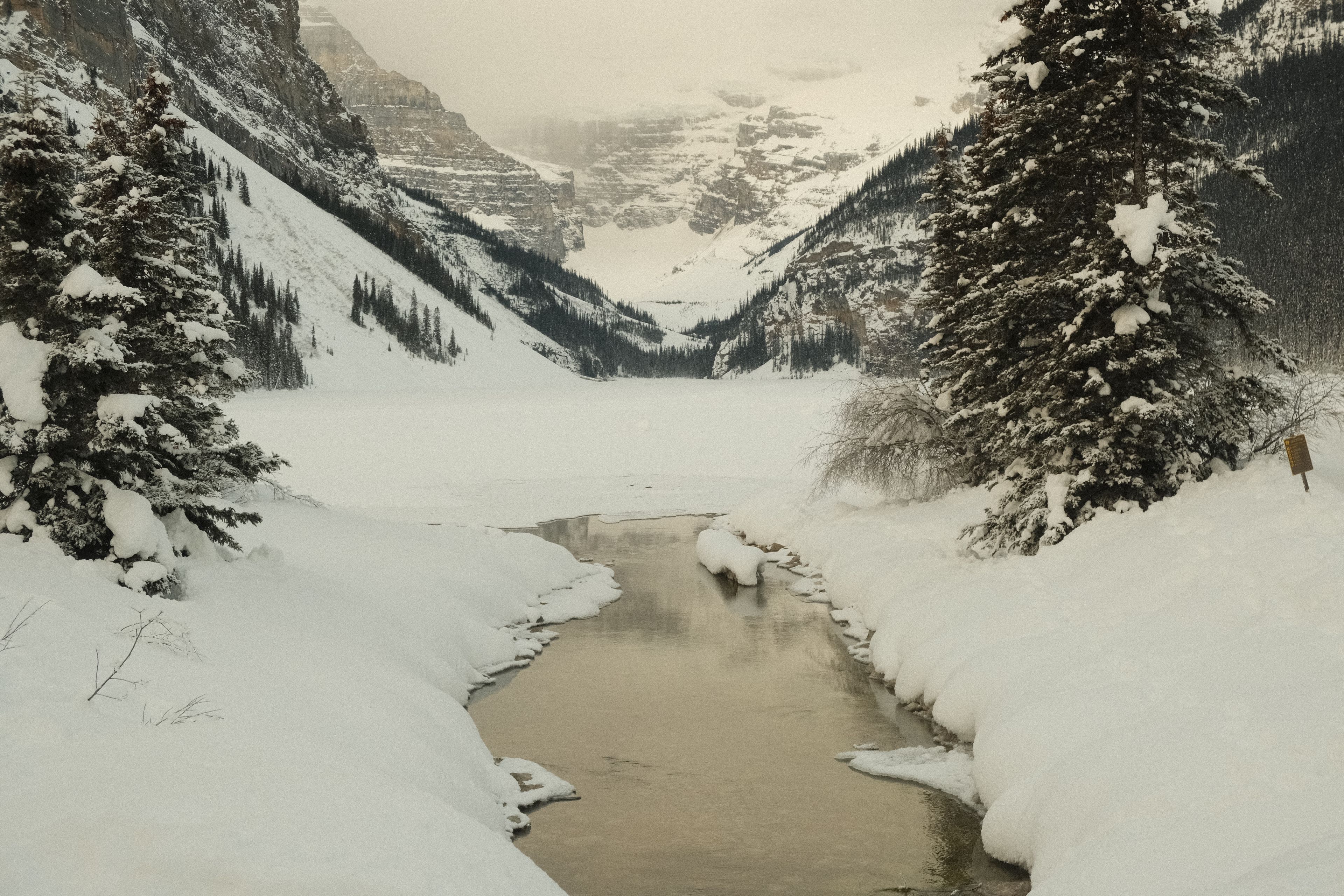
Lake Louise
When fresh snow lowers the volume of the whole valley.
Lake Louise is famous in every season, but it is most honest when it goes quiet.
After snowfall, the familiar shoreline softens and the scale changes; everything becomes closer.
You come for the color, but you stay for the hush that makes you listen differently.
The Ten-Minute Silence After the Plows Pass
Most visitors arrive when the lake already looks “done”: paths stamped flat, viewpoints busy, the surface interpreted for them. But right after a snowfall, there’s a short interval—often mid-morning, sometimes late afternoon—when the plows have just cleared the road and the foot traffic hasn’t returned. The air still holds snow-dust, and the usual hard edges around the Fairmont disappear under a clean, unclaimed layer. Listen for the small sounds: the faint squeak of fresh snow under boots, a single branch releasing its weight, the distant slide of a shovel blade. Walk a little past the main shoreline and notice how the lake behaves when it is partially iced and partially open. The open patches don’t “reflect” like summer; they absorb, turning dark and patient, like ink. In that soft light, the place stops performing and becomes simply present—mountain, lake, weather—nothing added.
The First Hour After Snow Stops Falling
There is a moment Lake Louise has only in winter: when the snowfall ends, but the sky hasn’t decided to clear. The light is flat in the best way—no drama, no glare—just a quiet exposure that makes the lake feel near enough to touch. The mountains on either side lose their contrast and become a set of pale planes; you read them by their shapes rather than their details. If the lake is frozen, the surface takes on a matte quality, like pressed fabric. If it’s in a freeze-thaw shoulder period, the shoreline becomes a collage of thin ice, slush, and dark water. That is when the famous turquoise is absent, and something more subtle replaces it: a restrained palette that makes you notice minute shifts—smoke-like mist lifting off a darker patch, the gray-blue of shadow under a snow lip, the way a single track across the edge can look like a sentence. It feels transformed not by spectacle, but by quiet permission: the lake isn’t asking you to do anything.
The Reflections
After snowfall, reflections become selective. Open water holds a deep, softened mirror of the tree line, while frozen sections scatter light and break the mountains into pale fragments.
The Water
In winter the signature turquoise often retreats, replaced by steel-blue and near-black where water stays open. That darker tone comes from depth and low-angle light, with glacial silt less visually dominant when the surface is iced or shaded.
The Landscape
Mount Victoria and the surrounding peaks frame the lake like a quiet amphitheater, their snowfields smoothing the sense of distance. The shoreline tightens into clean lines: spruce, white banks, and the long, calm face of the valley.
Best Angles
Lakeshore in front of Fairmont Chateau Lake Louise
Stand near the center of the shoreline and frame straight down the valley toward Victoria Glacier; keep the snow banks low in the foreground for a clean, quiet lead-in.
Right (west) shoreline toward the canoe dock area
Walk a few minutes along the right side and shoot back toward the hotel and tree line; the human scale appears softly through snowfall residue without dominating the scene.
Lake Agnes Trail first switchbacks (winter conditions dependent)
From just above the lake, frame the shoreline as a pale arc; creators often miss how the lake reads as a shape, not a postcard, when snow simplifies the edges.
A quiet bench or snowbank away from the main cluster
Turn your back to the lake for a moment and watch snowfall settle into the spruce; the lake’s mood is often strongest when you stop photographing and let the silence land.
Crowd pattern — busiest from late morning to mid-afternoon; quietest early morning, and briefly right after a snowfall before crowds return.
Effort level — minimal for the main viewpoint; winter traction helps for any shoreline wandering or trail starts.
Access note — Banff National Park entry pass required; winter conditions can affect trails and road safety (check Parks Canada updates).
What to bring — microspikes, insulated boots, a warm layer for standing still, and a lens cloth (snow-dust and mist can haze glass quickly).
Handpicked Stays & Tables
Places chosen for beauty and intention, not algorithms. Each one is worth your time.

Fairmont Chateau Lake Louise
On the lakeshore

Post Hotel & Spa
Lake Louise Village

Fairview Bar & Restaurant
Fairmont Chateau Lake Louise

The Station Restaurant
Lake Louise Village
After snow, Lake Louise doesn’t shine—it settles, and the valley settles with it.