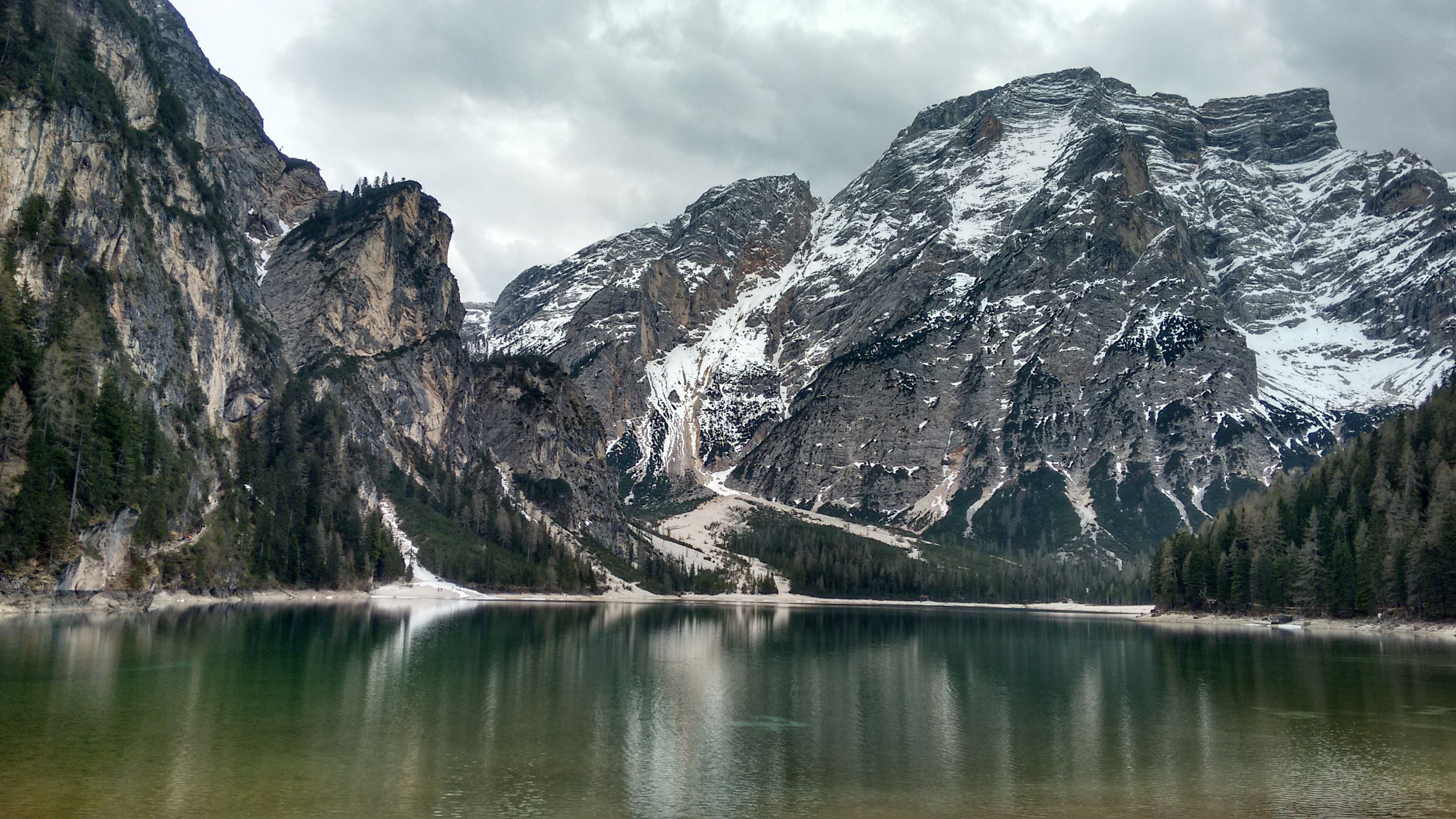
Lake Braies
Late morning, when the west bank stops performing.
Lake Braies is often seen at its loudest—early, bright, already watched.
But it has a second face that appears only when the sun moves and the valley cools.
In shade, the lake feels less like a postcard and more like a place you can breathe with.
The West Bank, After the Light Leaves the Water
Most visitors arrive with the same intention: catch the teal, catch the boathouse, catch the mirror. They stand on the eastern side where the lake reads clearly, then they leave once the surface turns busy with oars and voices. What gets missed is how the west bank behaves in late morning, when Croda del Becco and the forest start throwing shade across the water. The color doesn’t disappear—it deepens. The lake stops flashing and begins absorbing. The rock faces across the water look less dramatic, more detailed: seams, pale scars, the soft grit of limestone rather than a single bright wall. Walk the western path where the trees crowd the edge and the air stays cooler. In this shade, sound changes first: boat knocks become muffled, conversation thins, and you notice smaller things—drips from branches, the low ripple that keeps the shoreline from being perfectly still. It’s the same lake, but it no longer asks to be captured.
10:30–12:00, When the Shade Reaches the Waterline
Lake Braies transforms when the sun climbs high enough to stop lighting the west bank from the side. Sometime around late morning—often between 10:30 and noon, depending on season—the shadow line slides down from the trees and finally touches the water near the western shore. The change is quiet and physical, like someone lowering the volume in a room. The surface loses its sparkle first. Reflections become less literal, more tonal: dark spruce becomes a dense band; the cliff across the lake turns from bright stone into a cooler, layered presence. Even the common viewpoint feels different because the water is no longer competing with the sky. Faces relax. People linger without needing to do anything. If there’s no wind, the shaded water looks heavier, as if it has more depth than it did an hour earlier. If a light breeze arrives, it doesn’t ruin the mood—it makes a thin, brushed texture that catches only in small patches, leaving the rest matte and calm.
The Reflections
In late-morning shade, reflections stop being mirror-sharp and become velvety bands—forest as a dark ribbon, cliff as a pale smear with edges you can still read. When the lake is windless, the shaded side holds a steadier, calmer reflection than the sunlit water.
The Water
The water shifts from bright turquoise to a deeper blue-green, especially along the western edge where shade removes glare. That darker tone is the same mineral clarity, just revealed without sun on the surface.
The Landscape
Croda del Becco stands like a back wall, but shade makes it feel closer and more textured rather than monumental. The surrounding spruce creates a contained, quiet frame, and the valley air stays cool along the west bank even in summer.
Best Angles
West bank footpath, midway along the shore
Stand close to the trees and aim across to the cliffs; frame the darker water foreground with the pale rock beyond.
Small openings in the forest on the western side
Use the shade as a natural vignette; shoot outward toward the brighter east to let the lake read in layers, not glare.
North end near the inlet area (quiet edge of the loop)
Creators skip it; the water here often shows finer ripples and subtler color shifts, especially when the main basin is busy.
A bench or still patch of shoreline on the west bank
Sit facing across the water without framing anything; let the change be auditory—oars, wind in spruce, the lake settling.
Crowd pattern — earliest morning and late afternoon are calmer; mid-morning through early afternoon is typically busiest near the boathouse.
Effort level — the loop is mostly flat and gentle; the west bank can feel cooler and slightly damp under trees.
Access note — parking and access are often regulated in peak season; expect fees and possible time-slot or traffic controls.
What to bring — a light layer for the shaded west side, quiet shoes for the forest path, and a small cloth for lens/phone (shade can make condensation noticeable).
Handpicked Stays & Tables
Places chosen for beauty and intention, not algorithms. Each one is worth your time.

Hotel Lago di Braies
On the lake’s edge

Hotel Union
Dobbiaco/Toblach

Restaurant Hotel Lago di Braies
By the lake

Hans Pizzeria Restaurant
Dobbiaco/Toblach
On the west bank, when the light leaves, Braies finally stops asking to be looked at.