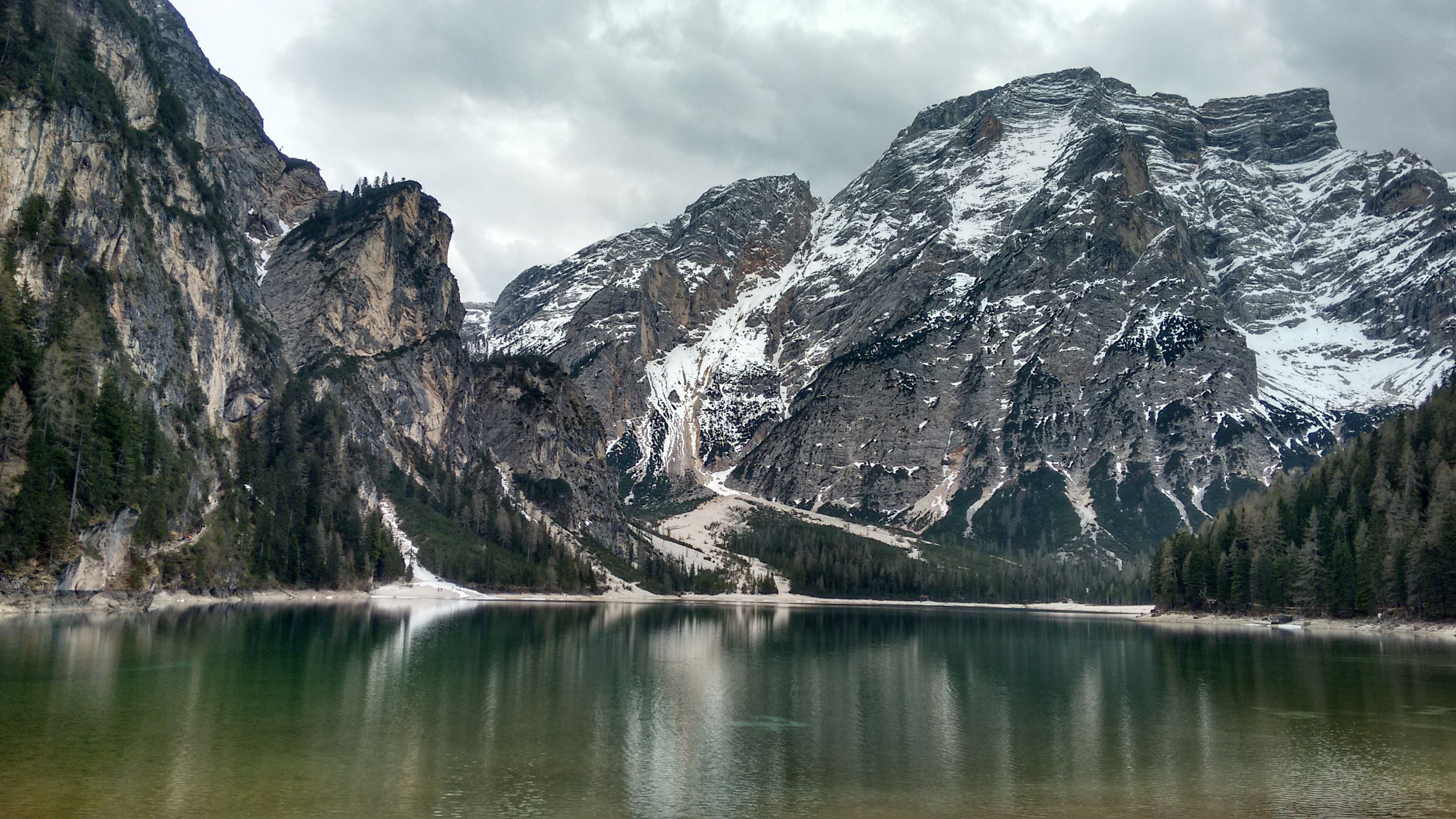
Lake Braies Sunset
When the emerald lets go, and the mountains start to look heavier.
Lago di Braies sits high in a bowl of pale rock and dark spruce, a lake that seems lit from within.
Most alpine lakes fade gently at day’s end; Braies changes character, as if someone lowers the temperature of the scene.
It matters because it teaches you to watch for the exact minute beauty stops performing and becomes honest.
The West End After the Rental Boats Return
Most visitors orbit the wooden boathouse and the postcard view toward Croda del Becco, then leave when the light begins to soften. What they miss is how quickly the lake quiets once the oars stop. Walk toward the western end, near the outflow and the flatter, reed-fringed edges. Here, the water loses its showroom sheen and starts to show its actual surface: small, nervous seams of current, faint rings from insects, the occasional bubble rising from the cold. The mountains don’t disappear; they simply stop insisting on attention. In this corner, the path is still close, but the sound changes—less camera chatter, more footsteps on gravel, a low hush from the forest. You notice the color shift first in the shallows: emerald draining into grey-green, then into a hard, mineral tone. It feels less like a scenic stop and more like a place that belongs to itself.
The Ten Minutes After the Sun Drops Behind Croda del Becco
Braies transforms in the brief window right after the sun slips behind Croda del Becco and the direct light leaves the basin. It’s not the golden-minute version of the lake. The change is quieter and sharper. The bright green that looks almost tropical in midday turns restrained, like metal under water. Shadows climb down the rock faces and the spruce line begins to merge into one dark band. In those ten minutes, the lake becomes more reflective in a different way: not mirror-smooth, but more willing to hold the darker tones of the mountains. If there’s no wind, the surface tightens and the reflected cliff edges look cut with a blade. If a breeze arrives, it breaks the image into fragments and the whole scene becomes more human—less perfect, more real. Stay through it. The crowds tend to leave precisely when the mood arrives, and the lake’s voice gets lower.
The Reflections
When the air stills, Croda del Becco appears in the water as a dark, clean silhouette, with the treeline forming a second horizon. After the sun drops, reflections lose their brightness and gain contrast—rock becomes ink, forest becomes velvet.
The Water
In direct light the water reads as emerald because of glacial minerals and the pale lakebed catching the sun. At sunset, once the basin falls into shadow, that green collapses into steel-grey and deep bottle tones, as if the color is being withdrawn rather than changed.
The Landscape
The lake is framed tightly: spruce forest at the rim, pale scree slopes, and the face of Croda del Becco anchoring the view. As evening comes on, the basin feels enclosed, and the mountains look closer—less like a backdrop, more like walls.
Best Angles
Boathouse pier facing Croda del Becco
Stand at the end of the wooden pier and frame straight north toward the peak; arrive 20–30 minutes before sunset and hold your position through the shadow drop.
East shore path (opposite the boathouse)
Walk a few minutes along the trail and shoot back toward the boathouse; the lake looks calmer here, with the timber building and dark trees sitting low in the frame.
West end near the outflow
Creators often skip it because it feels less iconic; it’s where the color shift shows first in the shallows and the lake surface reveals its small movements.
Forest edge behind the main path
Step a few meters into the trees and look back through trunks toward the water; it’s an intimate, quieter composition—less sky, more mood.
Crowd pattern — Midday is dense around the boathouse; late evening thins quickly, especially once the boats stop and day-trippers head back down the valley.
Effort level — Minimal walking on wide paths; the full loop is easy but includes some narrow sections and uneven ground along the rocky shore.
Access note — Parking and access rules can be seasonal and controlled; check current Val di Braies road restrictions and parking availability before you go.
What to bring — A light jacket even in summer (the basin cools fast after sunset), a small towel if you sit on damp rocks, and a quiet lens cloth—spray and fine moisture can arrive in the blue hour.
Handpicked Stays & Tables
Places chosen for beauty and intention, not algorithms. Each one is worth your time.

Hotel Lago di Braies (Pragser Wildsee)
On the lake’s edge

Hotel Union
Dobbiaco/Toblach

Restaurant at Hotel Lago di Braies
Beside the lake

Hans Pizzeria Restaurant
Dobbiaco/Toblach
Wait until the emerald lets go—then Braies finally feels like a lake, not an image.