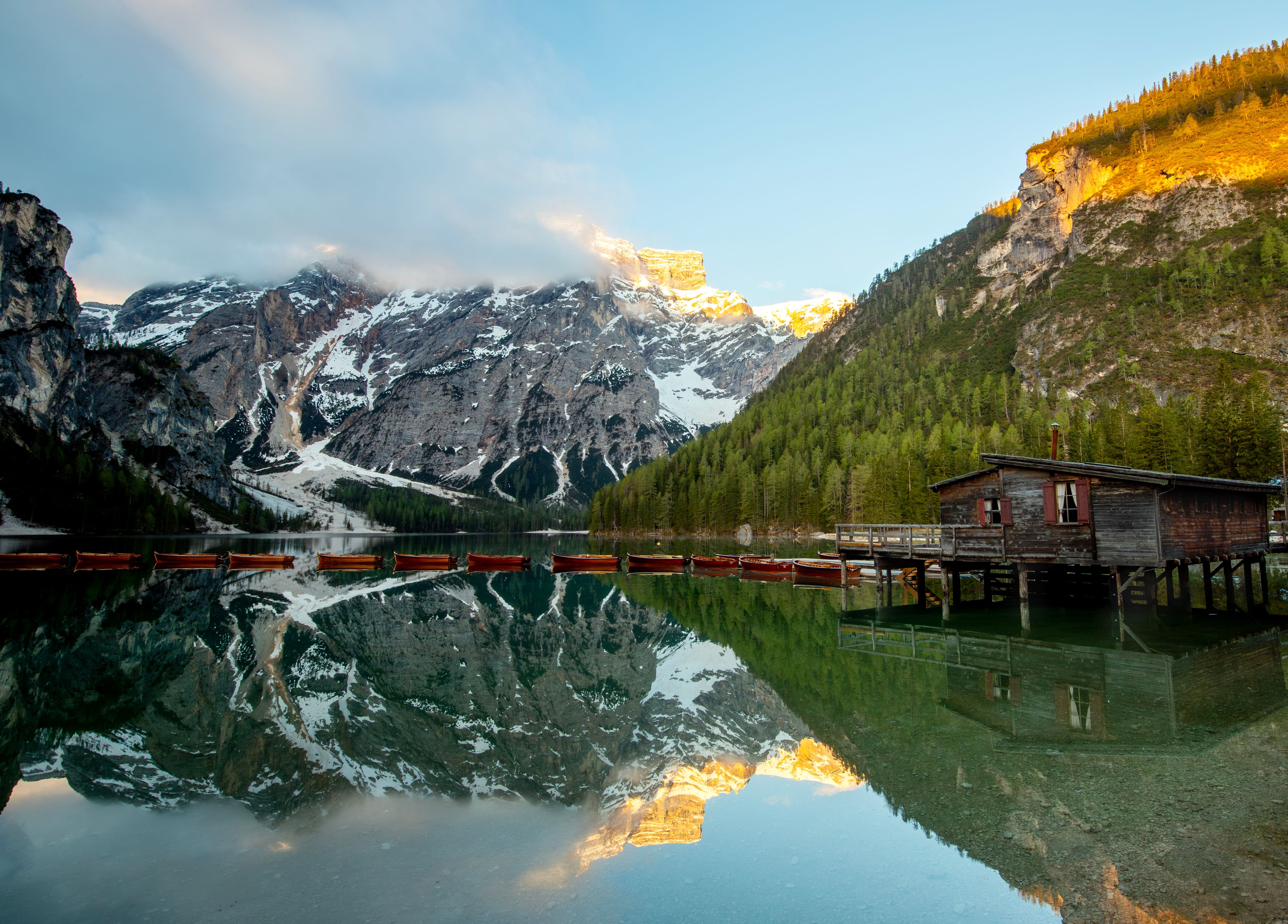
Lake Braies Sunrise
Where the oarlocks stop clicking and the water holds its breath.
Lake Braies is often introduced through noise: footsteps, shutters, the first boats being unlatched.
But at the far end, the boardwalk thins out and the lake becomes less of a scene and more of a surface you can read.
It matters because it teaches a small kind of patience—waiting until the famous view stops performing and turns quiet again.
The Far End, Where the Boardwalk Stops Being a Stage
Most mornings at Lago di Braies begin at the boathouse, where the lake is already a postcard and everyone behaves accordingly. The mistake is staying there, letting the first impression be the only one. If you keep walking—past the photo clusters, past the last neat sections of timber—you reach the far end where the path turns simpler and the sound of people arrives only in fragments. Here the lake doesn’t feel smaller, it feels deeper. The water is darker near the bank, stained with shadow from the trees and the steep wall of rock that holds the valley. You notice details that don’t read well in a wide shot: a thin line of mist that clings low, the soft clack of stones shifting under the lapping edge, the way reflections become less perfect and more honest. It’s the same lake, but no longer presenting itself. It’s just being there.
The Ten Minutes Before the Sun Touches the Water
The transformation at Lake Braies happens before sunrise, not after it. There is a brief window—often ten minutes, sometimes less—when the mountains are lit at their upper edges while the lake remains in shade. The water turns into a quiet mirror with a muted, metallic calm, and the surface seems to tighten, as if wind has forgotten this valley. At the far end, you feel the change more clearly because you’re not surrounded by the ritual of the boathouse. The first light arrives as a slow brightening on the pale rock faces and the thin treeline, not as a sudden wash of gold. Then, almost imperceptibly, the lake begins to take color: a colder turquoise where it catches the sky, a deep green-black where it keeps the shadow. When the sun finally clears the ridge and touches the water, the spell breaks a little—beautiful, but louder. The earlier moment is the one that stays.
The Reflections
In calm conditions the far end gives you layered reflections: dark spruce lines at the edge, then the pale rock above, then a faint, cooling sky. The image isn’t perfectly symmetrical—small ripples soften it into something more like brushwork than glass.
The Water
The water reads as milky turquoise where it opens to the sky, caused by glacial minerals suspended in the lake. In shade it shifts toward deep green and graphite, especially along the wooded banks where the valley keeps the light from reaching down.
The Landscape
Braies is framed by steep Dolomite walls that feel close, as if the lake is set inside a stone bowl. Early mist is thin and local—more a low veil near the surface than dramatic fog—appearing in patches where the night air lingers.
Best Angles
Far-end shoreline looking back toward the boathouse
Stand where the path flattens near the narrower end; frame the lake as a corridor of water leading to the peaks. Shoot westward as the first light catches the upper rock while the water stays shaded.
East-side footpath just beyond the busiest boardwalk section
Step off the rhythm of the planks and onto the quieter trail; keep the tree line close in the foreground for scale. This angle makes the lake feel enclosed and private even when it isn’t.
Low rocks at the waterline on the far end
Most creators stay at eye level; go low and let the reflections do the work. A few centimeters above the surface turns the lake into a plane, and the mountains become a soft second world.
A still pause facing the darker, wooded bank
Turn away from the iconic view for a minute. Watch the color change in the shadowed water and listen for the moment the valley wakes—birds first, then distant voices, then oars.
Crowd pattern — Sunrise is the calmest, but the boathouse area gathers people quickly; late morning through mid-afternoon is consistently busy in summer.
Effort level — Mostly flat walking on paths and boardwalk; the full loop is gentle but can be slippery after rain or in shoulder-season frost.
Access note — Parking and access rules can change seasonally in Val di Braies; in peak summer there may be traffic limits and shuttle requirements. Check local updates before you go.
What to bring — A warm layer even in summer (the valley holds cold air), quiet shoes with grip for wet planks, and a small light for pre-dawn walking.
Handpicked Stays & Tables
Places chosen for beauty and intention, not algorithms. Each one is worth your time.

Hotel Lago di Braies
On the lakeshore

Hotel Trenker
San Vito di Braies (Prags)

Restaurant at Hotel Lago di Braies
By the lakeside hotel

Gasthaus/Restaurant in San Vito di Braies
San Vito di Braies
Walk far enough that you stop hearing the lake being watched, and you’ll finally hear it being itself.