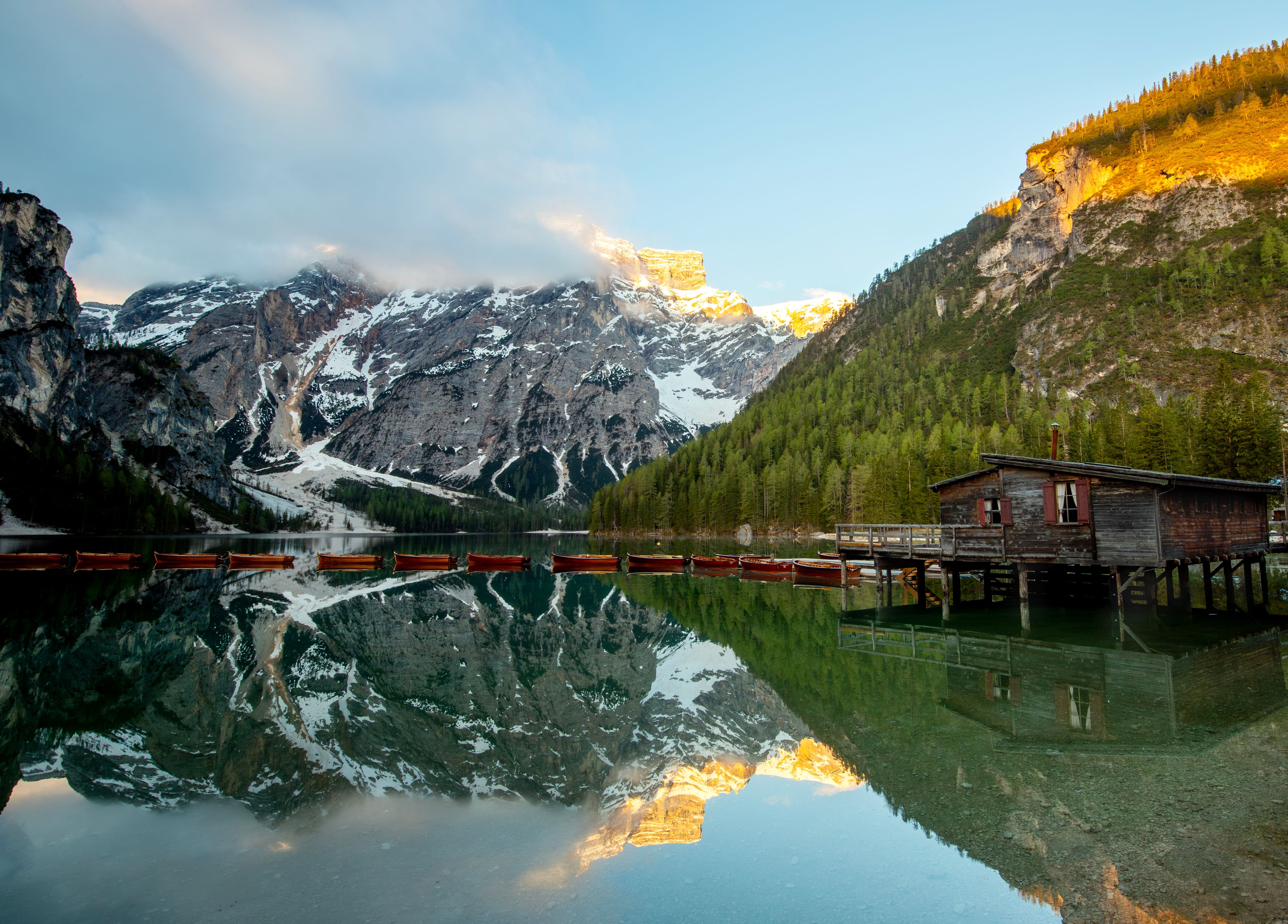
Lake Braies Sunrise
When the water turns to slate and the mountains go quiet.
Lake Braies is small enough to read like a room, but deep enough to hold weather.
Unlike many Dolomite lakes, its shore is intimate and built—wood, stone, paths—so light changes feel immediate.
It pulls you in because the familiar postcard view can suddenly dissolve into something softer, almost private.
The Minutes Before the First Oars Touch
Most visitors meet Braies when it is already performing: boats aligned, voices on the boardwalk, the water turned into a clean mirror. But the lake’s quieter character lives earlier, when the boathouse is still shut and the shoreline feels unassigned. On a storm-gray dawn, the timber looks darker and heavier, and the usual symmetry breaks—because the mountains refuse to show you their full faces. Stand near the boathouse but look away from it, toward the low western edge where the path curves and the spruce press close. Here the lake is not an emblem; it is just water breathing under a ceiling of cloud. The color shifts toward graphite, and small ripples travel without purpose, as if the wind is deciding whether to arrive. In this hour, Braies doesn’t ask to be photographed. It asks to be watched until you notice how quickly the mood can change.
Storm-Gray Dawn, When the Dolomites Lose Their Edges
The transformation happens on mornings when the forecast looks disappointing: low cloud, fine rain in the air, a flat light that would ruin a summit view. Arrive in the last stretch of darkness—when the lamps near the hotel still matter—and wait for the first thin brightening behind the cloud. There is no dramatic sunrise line. Instead, the lake lightens by degrees, like paper absorbing water. The Dolomites across the lake stop being “mountains” and become shapes: pale mass, darker seam, a suggestion of cliff. Edges disappear first. Then, briefly, the forest line gains contrast, and the water turns into a single slab of moving gray. If you stay still, you hear what the day sounds like before it becomes a day: a distant door, a cough, the faint knock of rigging, and the small, constant hush of rain landing on the surface. For ten minutes, Braies belongs to weather, not to people.
The Reflections
In storm light, reflections are incomplete: the treeline appears first, then the mountains arrive as smudged blocks rather than crisp peaks. The surface reads like brushed metal, interrupted by pinprick circles where rain lands.
The Water
The famous milky turquoise recedes into a muted blue-green under cloud, then shifts toward slate as the sky thickens. The color comes from glacial rock flour, but the weather decides how much of that brightness you’re allowed to see.
The Landscape
Steep Dolomite walls usually frame the lake with hard geometry; on gray dawns they soften, as if the limestone has been rubbed smooth. Dark spruce stands tight along the shore, making the water feel enclosed and sheltered.
Best Angles
Boathouse steps (north shore)
Stand just off-center from the classic lineup and face south-southeast; frame the dark timber against the pale lake and let the mountains fade into cloud rather than fighting for clarity.
East-shore path toward the chapel (Kapelle am Pragser Wildsee)
Walk a few minutes until the boardwalk noise drops; look back across the water for a softer, wider composition where the hotel lights (pre-dawn) feel like a small, human scale against the weather.
Southwest curve of the loop trail
Creators often skip this side because it’s less iconic; from here, the lake feels more forested, and storm cloud layers read as depth rather than backdrop.
A bench under spruce on the west side
Sit facing the open water without composing anything; this is where you notice the sound of rain on the lake and the moment the day’s first movement starts on shore.
Crowd pattern — Sunrise is quietest; late morning through mid-afternoon is busiest, especially in summer when the boathouse area becomes a queue of cameras.
Effort level — Minimal walking if you stay near the north shore; the full loop trail is gentle but can be slick in rain.
Access note — Parking fees and seasonal access controls may apply in summer; check Pragser Wildsee regulations for shuttle/time-slot requirements.
What to bring — A rain shell, shoes with grip for wet boards and stone, a small towel for lenses/phone, and a warm layer even in summer (the valley holds cold air at dawn).
Handpicked Stays & Tables
Places chosen for beauty and intention, not algorithms. Each one is worth your time.

Hotel Lago di Braies (Pragser Wildsee Hotel)
On the lake’s north shore

Naturhotel Leitlhof
San Candido (Innichen)

Restaurant at Hotel Lago di Braies
Pragser Wildsee (on-site)

Gourmetstube Einhorn (Hotel Elefant)
Bressanone (Brixen)
When Braies turns gray, it stops posing and starts feeling like a place you can finally enter.