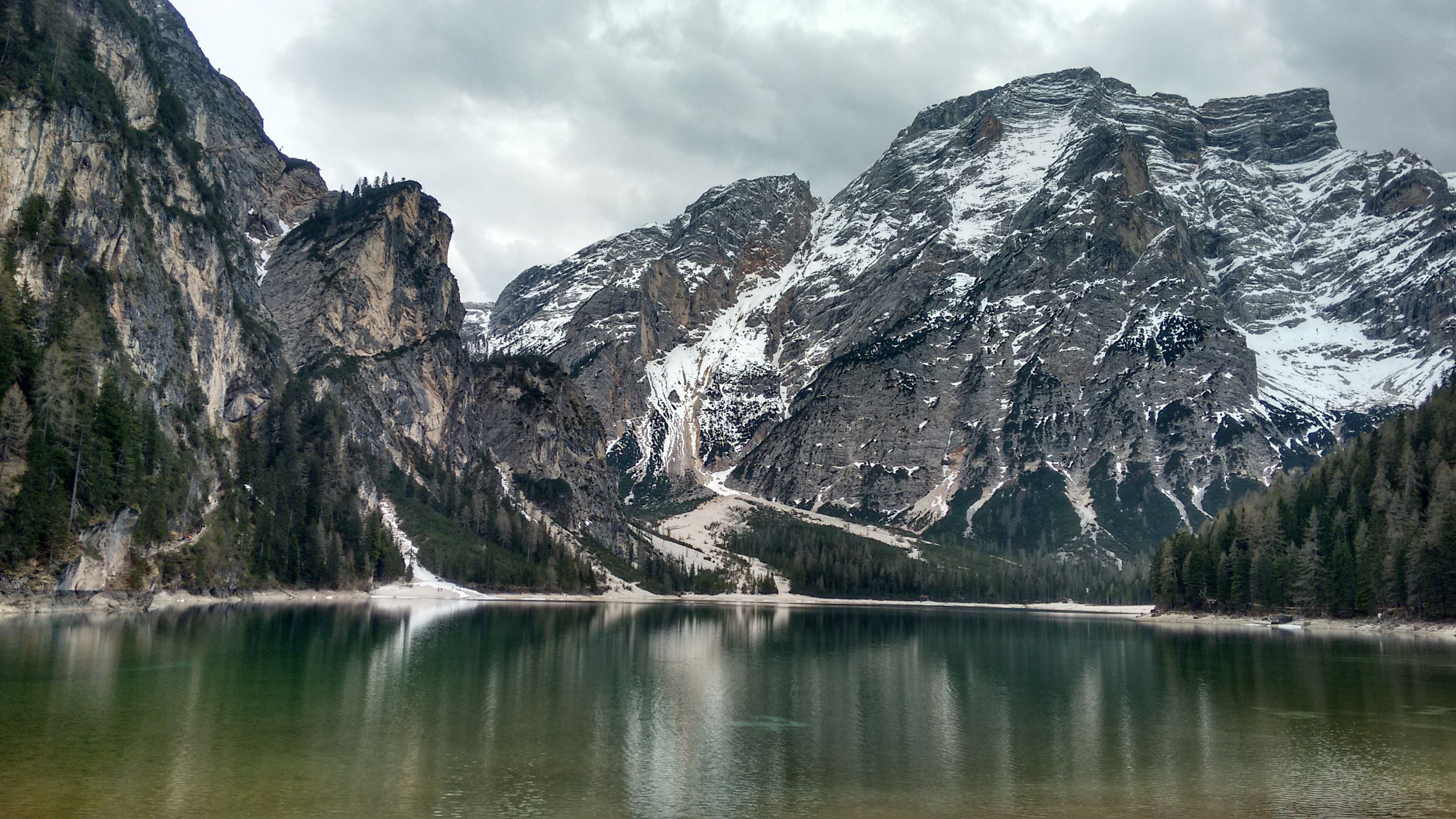
Lake Braies
When the surface holds the mountains without a tremor.
Lake Braies sits at the end of a quiet valley, where sound arrives late.
Its scale is small enough to feel intimate, yet the cliffs make it feel steep and solemn.
It pulls you back to attention—toward light, toward stillness, toward what changes in minutes.
The Shoreline Behind the Boathouse, Before It Opens
Most visitors stop at the wooden boathouse, take the familiar frame, and move on. But in the early morning—before the first oars touch water—there is a narrow, almost unremarkable strip of shoreline just beside and behind it where the lake is closest to its own silence. The boards and railings creak less, voices haven’t started to bounce off the rock, and the water isn’t yet broken into small, nervous fragments. Stand there and watch how Lake Braies gathers detail: the dark line of submerged stones near the edge, the pale wood reflected with uncanny clarity, the way the larches and spruces appear not as trees but as vertical brushstrokes in the surface. You also notice something else: the lake is not uniformly turquoise. Near the shore it turns clearer, almost colorless, and you can see the depth arrive gradually, like a slow inhale. This is the Braies most people miss—less postcard, more presence.
The First Windless Ten Minutes After Dawn
Lake Braies turns to glass in a specific window: when the valley is still shaded, the sun has only just found the upper rock faces, and the air hasn’t begun to move. It’s not exactly sunrise by the clock—it’s the moment when light starts to slide down the mountain wall and the lake receives it without ripples. In those first ten minutes, the water behaves like a held breath. The reflected cliffs look heavier than the real ones, as if the lake is carrying them. The boathouse seems to float in place, its reflection joining it like a second structure built in silence. Even small sounds—zippers, a camera strap tapping—feel too sharp for the scene. Then it changes. A breeze arrives down the valley, or the first boat pushes off, and the surface loosens. The perfect mirror doesn’t vanish dramatically; it simply becomes water again. That brief shift is the entire story here.
The Reflections
When the surface is calm, the north-facing cliffs and dark firs appear as clean, vertical doubles with almost no distortion. The boathouse reflection can align so precisely it looks like a hinge between two worlds.
The Water
The water reads as milky turquoise where fine glacial silt and limestone lighten the shallows, especially when sun begins to touch it. In shade it shifts cooler—blue-green with graphite undertones—because the surrounding rock keeps the light restrained.
The Landscape
Steep Dolomite walls close the lake in, making the basin feel sheltered and quiet rather than wide and open. The forest edge is tidy and dark, and in cold mornings a faint mist can hover low, softening the line where water meets trees.
Best Angles
Boathouse front (Lago di Braies boat rental area)
Stand slightly to the side of the dock, not centered—frame the boathouse with the cliff behind it; shoot toward the north end for the strongest mirrored wall.
East shore path, a few minutes south of the boathouse
Walk the lakeside trail until the boathouse slips out of view; look back for a quieter composition where the forest reflection becomes the subject.
North end of the loop trail (near the talus slope)
Most creators rush the dock; here, aim back toward the boathouse with the lake as negative space—best when the water is still and the shore stones show through.
A low crouch at the pebbled edge beside the dock
Forget the wide scene; frame only water, wood, and a thin strip of cliff reflection—this is where the lake feels closest, like it’s listening.
Crowd pattern — Early morning is the only reliably quiet time; mid-morning to afternoon can feel dense around the boathouse and main shore.
Effort level — Minimal walking to reach the water; the full loop is gentle but can be slippery near rocks after rain.
Access note — Parking and access rules can be seasonal; in peak summer periods, road access may be regulated with limited entry and paid parking/shuttle systems.
What to bring — A warm layer for dawn (the valley holds cold), shoes with grip for wet boards and stones, and a small cloth to dry lens mist near the water.
Handpicked Stays & Tables
Places chosen for beauty and intention, not algorithms. Each one is worth your time.

Hotel Lago di Braies (Pragser Wildsee)
On the lake’s edge

Hotel Villa Stefania
San Candido (Innichen)

Restaurant Hotel Lago di Braies
At the lake

Zin Fux (San Candido)
San Candido (Innichen) center
If you catch Braies before the first ripple, it feels less like scenery and more like a pause you can step into.