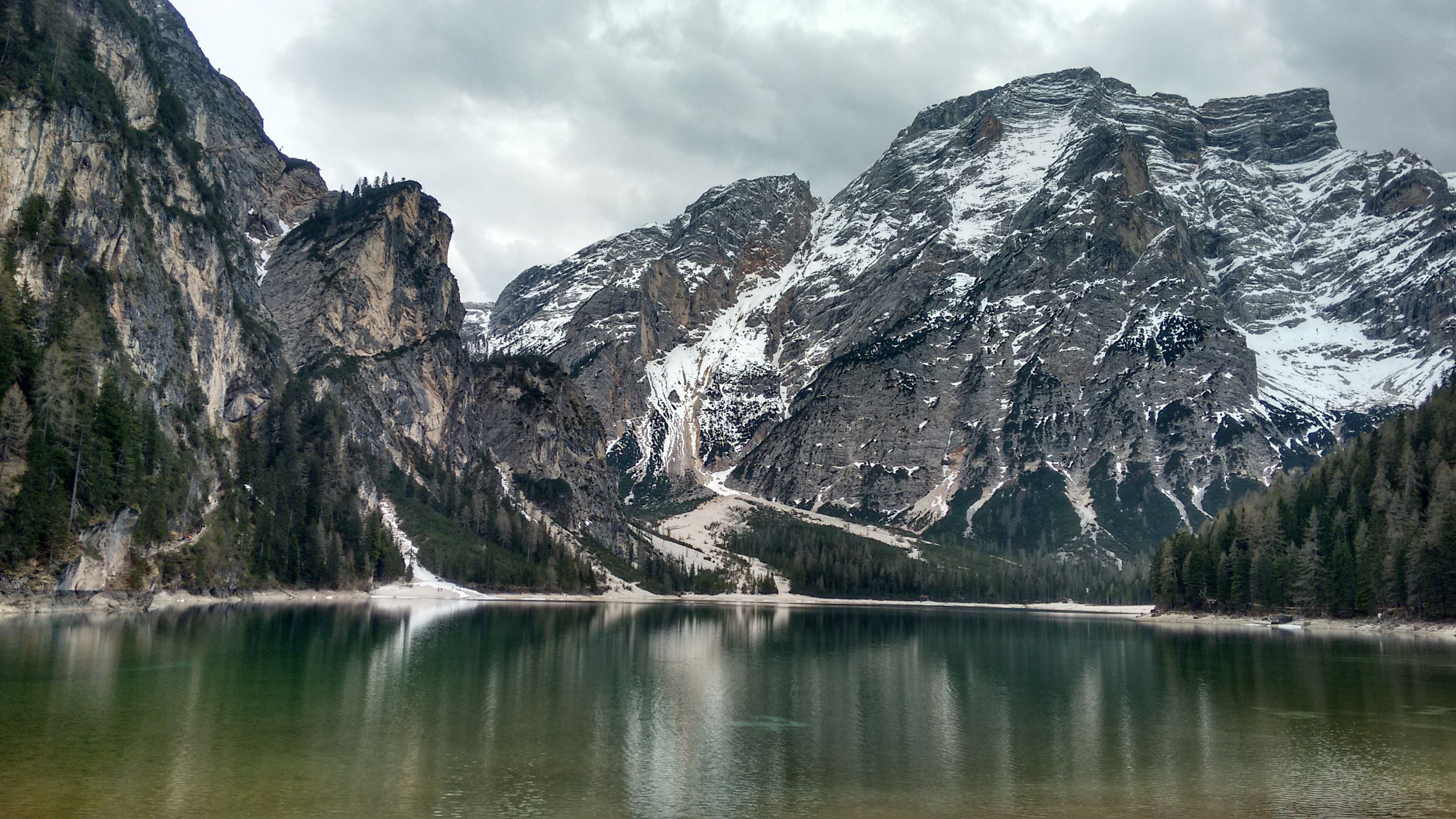
Lake Braies
Fresh snow turns the shoreline into silence you can see.
Lake Braies is usually remembered for its color and the little boathouse.
In fresh snow, it stops performing and becomes a study in quiet contrasts—wood, ice, stone.
It pulls you in not with drama, but with the relief of a place that finally feels unhurried.
The Boardwalk When Footsteps Turn to Hush
Most visitors come for the classic view across the water, then leave before the lake settles. In fresh snow, the real change happens along the wooden walkway on the western side, where the planks soften under a thin white layer and every step sounds smaller than you expect. The shoreline here is not a “path” so much as a gentle edge between forest and water. Snow clings to the low rail, rounds off the corners of benches, and quiets the small distractions—signs, stones, and boot prints—until the lake feels newly arranged. Look into the trees rather than out to the peaks: larch and spruce catch snow differently, creating a subtle pattern of dark needles and pale weight. When the lake begins to skin over near the margins, the ice forms in shallow, milky sheets that don’t photograph loudly but make the entire surface look calmer. The best detail is the boathouse itself—its red-brown boards deepening against the white, like a single warm note held in a cold room.
The First Hour After Overnight Snow, Before Anyone Rows
The transformation arrives early, before the day organizes itself. If snow fell in the night, come at first light—roughly 7:30 to 9:00 in mid-winter—when the parking area is still quiet and the lake is not yet marked by movement. The mountains above, Croda del Becco and the surrounding walls, appear closer because the usual visual clutter is erased; the forest becomes a darker frame, and the shoreline turns into a clean line. This is when the water looks heaviest. The turquoise that defines Braies is still there, but subdued, as if covered by a thin veil. Any breeze feels unlikely; the surface holds a low, unbroken reflection, interrupted only where snow lands from branches in soft, sudden drops. If the temperature has dipped enough, the edges begin to tighten into ice, and you can watch the lake gently “decide” where it will freeze first—bays, shallow corners, and the calmest pockets near the boathouse. The moment ends as soon as voices carry across the water.
The Reflections
In fresh snow, reflections become simpler and more graphic—dark forest and pale rock held on a smoother surface. When the wind is absent, the peaks repeat with a faint blur, like charcoal smudged on glass.
The Water
The water shifts from bright turquoise to a cooler, deeper teal-green, muted by low winter sun and shadow from the surrounding slopes. In shallow areas, the color turns milky near forming ice, where fine bubbles and snow-cooled water soften the clarity.
The Landscape
Steep Dolomite walls rise close behind the trees, making the lake feel enclosed and protected rather than wide-open. Snow reduces the scene to essentials: a dark band of forest, a pale rim of shore, and stone that looks newly washed.
Best Angles
Boathouse front (La Palafitta) looking south-southwest
Stand slightly to the left of the boathouse doors to include the snow-laced roofline and the first curve of shoreline; frame the dark forest as a quiet border behind it.
Western boardwalk midway along the lake
Face east across the water for a cleaner mountain profile; the snow on the railing leads the eye without feeling like a “trail shot.”
Northern end near the hotel side, looking back toward the boathouse
Creators often miss this reverse view: the boathouse becomes small and human, and the lake looks longer, with snow giving the far shore a soft, continuous line.
A few meters into the forest behind the western path
Turn away from the postcard and photograph the lake through dark trunks; it’s an intimate frame that matches the hush of fresh snow.
Crowd pattern — Midday is the busiest even in shoulder seasons; after fresh snow, early morning stays calm until tours and day-trippers arrive. In winter, quiet is most reliable at first light and near closing hours.
Effort level — Minimal walking to reach the shore; the full loop is easy but can be slippery or partially inaccessible depending on snow and ice.
Access note — Parking can be regulated by season and time; winter conditions may limit the loop path. Check local updates for closures and safe walking sections.
What to bring — Waterproof boots with good tread (or light traction), warm gloves for railing and camera handling, and a thermos—there are long stretches where you’ll want to linger without moving.
Handpicked Stays & Tables
Places chosen for beauty and intention, not algorithms. Each one is worth your time.

Hotel Lago di Braies
On the lakeshore

Hotel Hubertus
Valdaora (Olang), about 20–25 minutes by car

Restaurant Hotel Lago di Braies
Inside Hotel Lago di Braies

Ristorante Pizzeria Hans
Dobbiaco (Toblach)
In fresh snow, Lake Braies feels less like a destination and more like a pause that holds its shape.