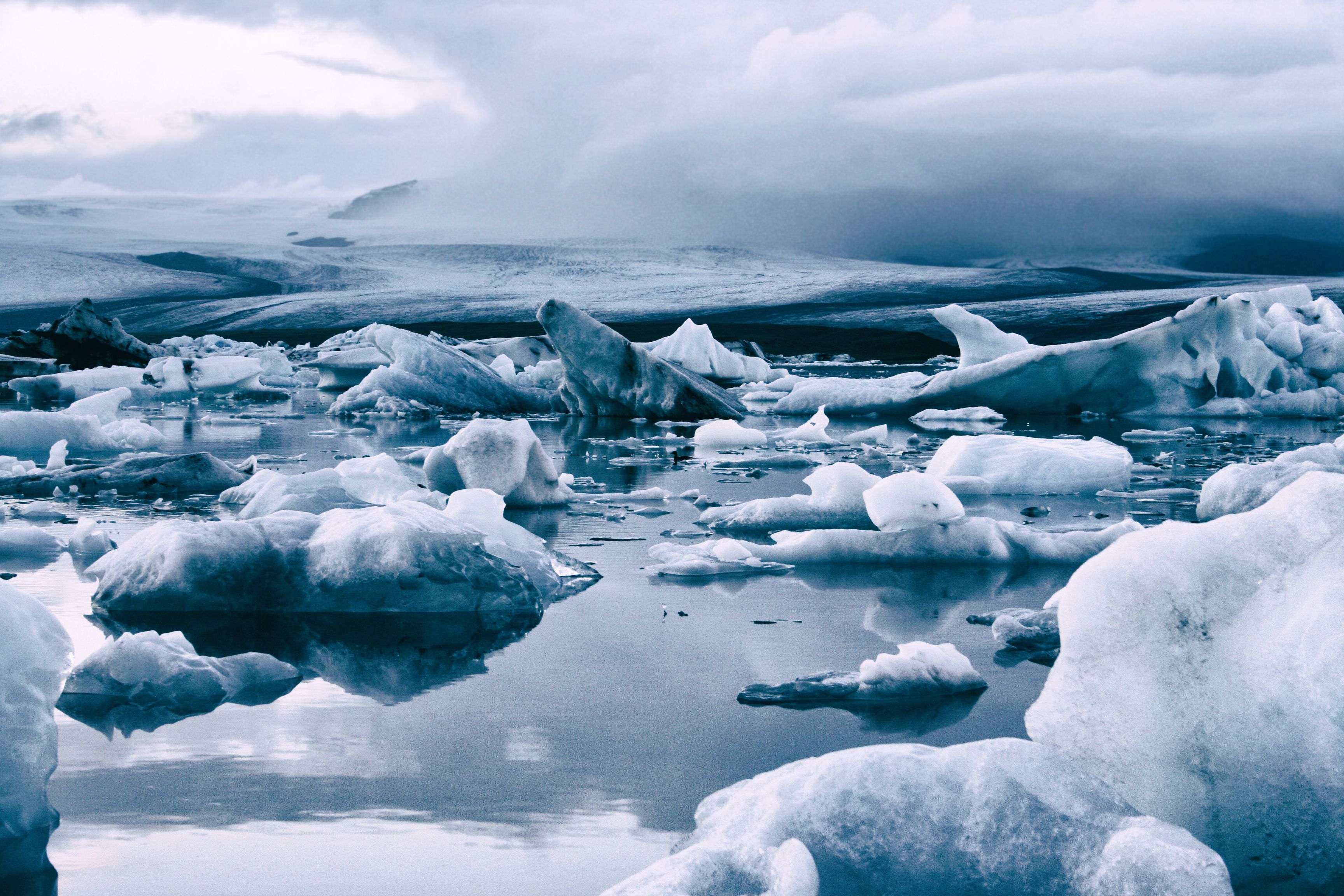
Jökulsárlón
When fresh snow mutes the ice and the lagoon turns quietly opaque.
Jökulsárlón is a lagoon that feels like a slow conversation between ice and sea.
Unlike most lakes, its surface is never finished—ice arrives, thins, rotates, disappears.
It pulls you in not with drama, but with the strange calm of something always changing.
The Lagoon Right After the Shine Disappears
Most people come for sparkle: blue ice lit like glass, black water polishing every edge. But Jökulsárlón has another face, and it often arrives quietly—after a soft snowfall. The ice loses its gloss first. Snow settles into seams and pits, turning each berg into a pale, matte shape with softened angles, like objects left out overnight. The lagoon follows. Instead of crisp reflections, you get a surface that looks slightly thickened, as if the water is holding its breath. Visitors still point their lenses at the biggest pieces near the shore, waiting for the glow to return. What they miss is the new contrast: the dark volcanic sand, the white-dusted ice, and the in-between tones—gray, pearl, faint blue trapped under snow. The sound changes too. Less dripping, less tinkling. Just the occasional low knock when two pieces meet and decide, slowly, to separate.
The First Hour After Snow Starts Sticking
The transformation begins when the snow stops melting on contact. At first it lands and vanishes, a brief whitening that feels like a trick of the eye. Then the temperature drops a fraction, the flakes hold, and the lagoon becomes visibly quieter. The ice takes on a powdered finish. Details blur: cracks soften, edges fade, the blue retreats inward. In that first hour, the water also changes its behavior. The usual glitter—tiny points of light on ripples—goes away. Wind still moves the surface, but it looks more even, less reflective, more like slate than mirror. If the snowfall is steady, the far side of the lagoon begins to dissolve into a gentle haze, and the outlet current looks darker, more deliberate. It’s a subtle shift, but unmistakable once you’ve seen it: Jökulsárlón stops performing. It becomes a study in muted tones and slow motion, where the most interesting thing is how little happens—and how complete it feels.
The Reflections
On clear days, the lagoon reflects ice and sky in hard, clean shapes, especially when the wind drops. After snowfall, reflections turn faint and broken—the surface reads more like brushed metal than glass.
The Water
The water is usually deep charcoal to green-black, colored by glacial silt and depth, with light catching only the thinnest ripples. During snow, it often looks flatter and grayer, as if the sky has been mixed directly into it.
The Landscape
Low, open shores keep the horizon wide, with Vatnajökull’s presence felt more than seen when clouds hang low. Snow compresses the scene: fewer colors, softer distances, the lagoon framed by silence rather than peaks.
Best Angles
Main parking shoreline near the lagoon edge
Stand slightly away from the crowd and frame low across the water toward the drifting ice; keep the horizon minimal and let matte textures fill the foreground.
The bridge on Route 1 over the outlet
Look down-current to catch the darker water threading between ice; on snow days, the contrast between white ice and black flow is strongest here.
Far side by the quieter eastern stretch of the shore
Walk a little along the edge and shoot back toward the busier end; you’ll get fewer people, more negative space, and a softer, more editorial mood.
A still pocket of water beside grounded ice near shore
Ignore the big bergs and watch the small, half-buried pieces; the best moment is when snow lands on them and you can hear almost nothing at all.
Crowd pattern — busiest from late morning to mid-afternoon; quietest early morning and during active snowfall when people tend to wait in cars.
Effort level — minimal walking on flat ground, but expect cold wind and slick patches near the edge.
Access note — parking is paid via Iceland’s standard pay systems; winter storms can close or slow Route 1, so check road.is and safetravel.is.
What to bring — waterproof boots with traction, windproof outer layer, thin gloves for handling a camera/phone, and a lens cloth (snow turns to mist quickly here).
Handpicked Stays & Tables
Places chosen for beauty and intention, not algorithms. Each one is worth your time.

Fosshotel Glacier Lagoon
Between Skaftafell and Jökulsárlón

Höfn Guesthouse (local options in town)
Höfn

Pakkhús Restaurant
Höfn

Heimahumar (The Lobster Shack)
Höfn harbor area
When the ice turns matte, Jökulsárlón feels less like a spectacle and more like a quiet decision made by weather.