Freedom Beach
A short swim from Patong’s noise, the sea turns quiet and the sand starts speaking.
Freedom Beach matters because it sits within earshot of Patong’s thrum—yet it feels like the island has exhaled. The bay is small, steeply held by forested slopes, and the waterline is clean enough that you notice sound: fins cutting, pebbles ticking, a longtail idling somewhere beyond the headland.
Most people treat it as a postcard—white sand, blue water, done. They miss what happens at ankle level: the sand is ribbed like corduroy, the rock pools hold miniature weather systems, and the shoreline changes character every few minutes as the swell rearranges it.
The payoff is subtle and immediate. You stop performing Phuket and start inhabiting it—watching light move through water, feeling the city fall away behind the hills, letting your attention get small in a place that’s usually sold as big.
The Sand Isn’t Smooth—It’s a Map
Freedom Beach looks simple from a lounger: bright sand, bright water, a reassuring curve. But the real story is written in texture. Walk the shoreline slowly and you notice the sand isn’t a blank white sheet—it’s patterned, ribbed, and constantly reprinted by the tide. Those ripples aren’t decoration; they’re the record of the last set of waves, the angle of the swell, the way the bay funnels water in and out. In late afternoon, the low sun makes each ridge cast a thin shadow, turning the beach into relief. At the edges, the granite is the opposite of the sand’s softness—dark, warm, and pocked with tiny basins. When the tide drops, those basins become rock pools with their own glassy surfaces. You see seaweed fronds trembling like slow flags, micro-bubbles clinging to stone, small crabs moving with a precision that feels rehearsed. If you snorkel along the rocks, the water goes a shade deeper and the life thickens—striped fish, occasional parrotfish, and the quick, nervous motion of juveniles using the boulders as cover. This is also where Patong fades in a way you can measure. Not by distance—by attention. The more you watch the shore’s small mechanics, the less you need the island’s loudest version of itself.
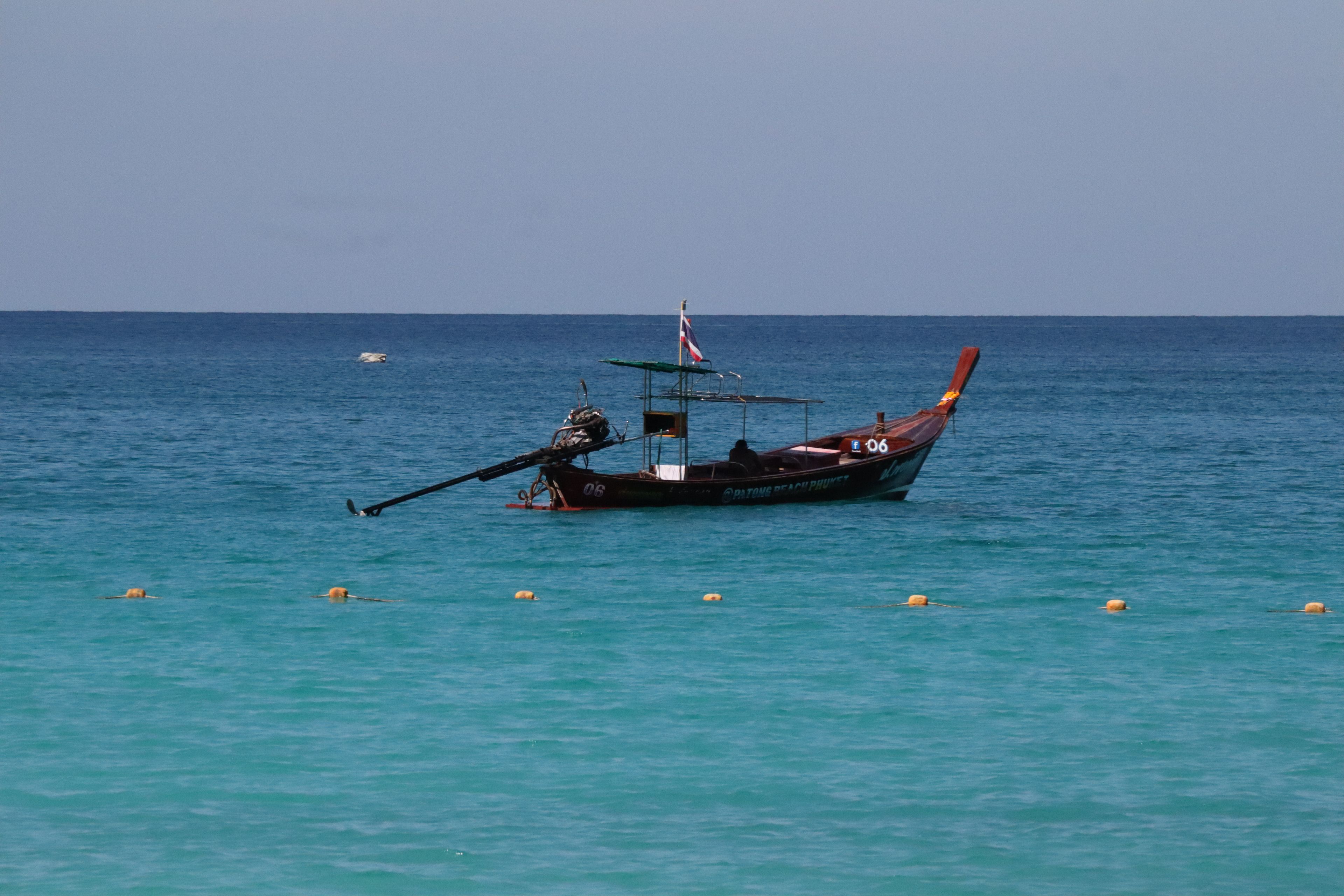
You arrive with Patong still on your skin—salt-sweat, sunscreen, the residual bass of traffic—but the path drops and the sound edits itself. The beach opens in a clean curve, framed by dark granite and dense green that leans toward the water as if listening. At the high-tide line the sand is pale and squeaks underfoot, then turns cooler and firmer where the sea has just been. You wade in and the temperature shifts—lukewarm at the edge, then suddenly clear and buoyant, the kind of water that makes your ankles look newly drawn. A longtail drifts outside the bay, its engine a low purr that fades when it turns. Near the rocks, the sea switches from turquoise to bottle-green, and you can see the bottom the way you see a tiled floor—ripples, shadows, a few darting fish that flash silver and vanish. Behind you, the hillside holds the beach like a sheltered room. The city is still there. It just can’t reach you.
The Water
In the middle of the bay the water reads as pale turquoise—milky-clear over sand, with a satin sheen in calm weather. Near the headlands it deepens to jade and bottle-green as the bottom turns rocky and shadowed.
The Cliffs
Freedom Beach is a pocket bay carved between granite headlands, with a short ribbon of sand backed by steep, forested slopes. The rocks create natural boundaries that calm the water and give the shoreline its tide-pool edges.
The Light
Late afternoon brings side-light that sculpts the sand ripples and warms the granite to a bronzed tone. Morning can be brighter and flatter, but the water clarity often looks crispest before the wind picks up.
Best Angles
North headland boulders
Climb carefully onto the low rocks for a framed view back across the curve—sand ripples in the foreground, boats and horizon held neatly beyond.
South end rock-pool shelf
At lower tide, you get intimate textures—pitted granite, clear pools, and the water shifting from pale to deep within a few steps.
Mid-beach at the waterline
Kneel low and shoot along the shore to capture the corduroy sand pattern and the thin line of foam stitching it together.
Jungle edge behind the loungers
From the shade line you can layer palm and broadleaf silhouettes against bright water—ideal for exposure play and a premium, editorial feel.
Snorkel line along the northern rocks
The unexpected angle is underwater: look back toward the beach and you see the bay as a gradient of light, with swimmers floating like slow punctuation.
Bring reef-safe sunscreen and use it early; the sun reflects hard off pale sand and shallow water.
Wear footwear with grip for the access path and for stepping onto granite near the waterline.
Pack a snorkel mask; the best color and fish life sit along the rock edges, not the center of the bay.
Carry cash for entry/parking and simple beach services; card options can be inconsistent.
Check sea conditions if you plan to arrive by boat—chop can turn the short crossing into a wet, bumpy ride.
Handpicked Stays & Tables
Places chosen for beauty and intention, not algorithms. Each one is worth your time.

Rosewood Phuket
Tri Trang area, south of Patong
A low-slung, design-forward resort that feels embedded in the coastal landscape. You get quiet pools, refined service, and a sense of distance from Patong without leaving the area.

Amari Phuket
Patong Bay (southern end)
Close enough to dip into Patong’s energy, but angled toward calmer sea views. The terraces catch soft morning light, and the setting makes an easy base for boat trips to Freedom Beach.

Ta Khai
Tri Trang area (Rosewood Phuket)
Thai cooking with smoke, herbs, and restraint in a garden-like setting. It suits a post-beach evening when you want Phuket’s flavors without Patong’s volume.

Acqua Restaurant
Kalimpah, north of Patong
Italian fine dining with a calm, coastal sophistication. Go for a long dinner after sand and salt—clean lines, polished service, and a menu that reads like a reset.
You leave with sand on your ankles and a new sense of Phuket’s scale—the loud part is real, but it is not the whole island.