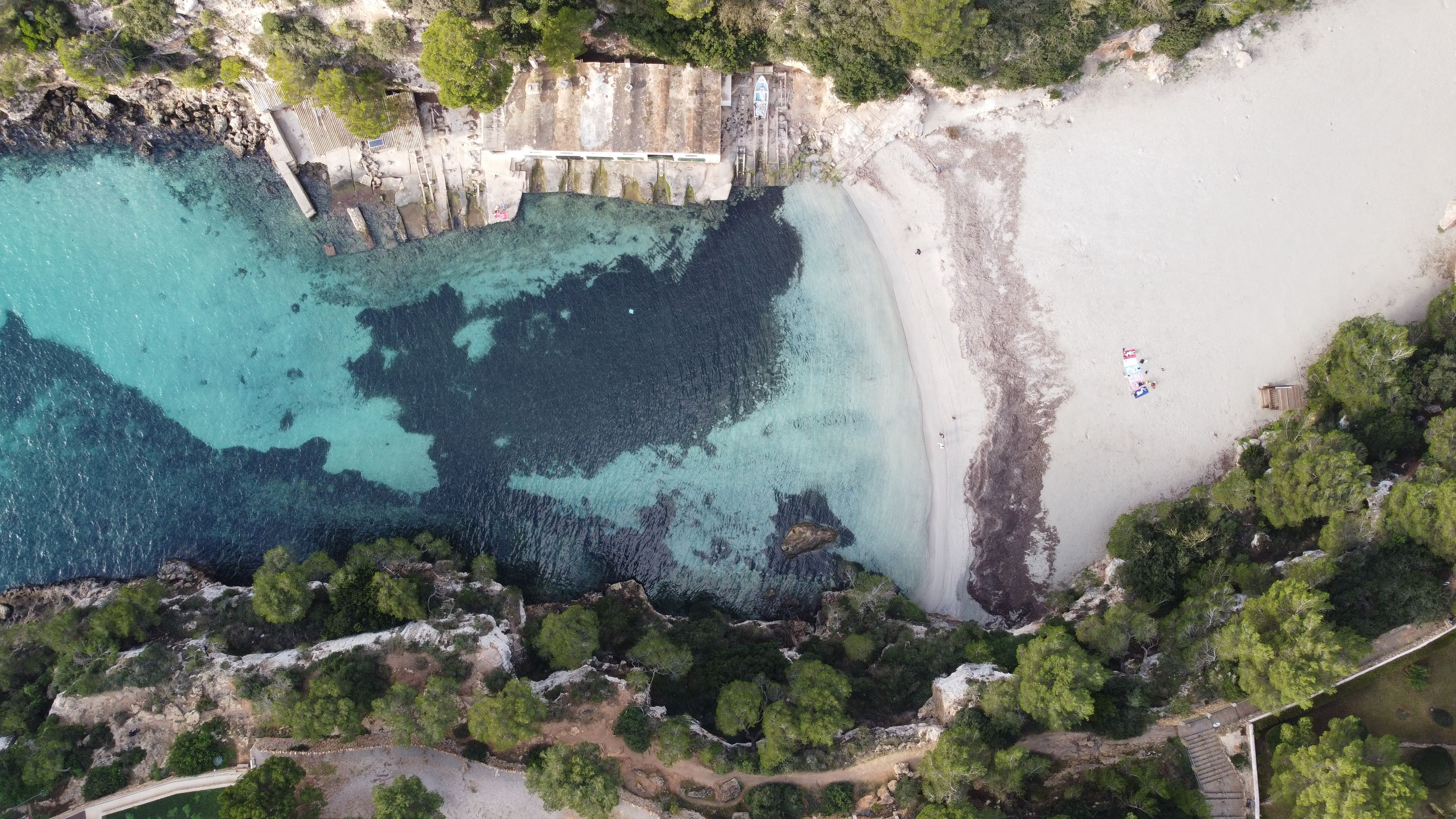
Cala Varques
Mallorca’s wild cove has a rope swing in the pines—if you look up before you look out.
Cala Varques matters because it still feels like a piece of Mallorca before the island learned to perform. You arrive on foot, not by playlisted beach club shuttle, and the first thing you notice is sound—the hush of pine needles, the low percussion of swell meeting rock, the occasional clink from a climber’s quickdraws on the cliffs.
Most people miss the vertical story. They come for the white sand and the Caribbean-bright water, then stop at eye level. But Cala Varques is a cove you read upward: limestone walls, sea caves, and—tucked into the canopy—a rope swing that turns the whole scene into a moment of courage and play.
When you do spot it, the cove changes. You’re not just lying in a pretty bay; you’re participating in it. The payoff is that rare travel feeling of being awake to a place—present, slightly nervous, and grinning at how quickly the world narrows to salt on your lips and the sway of a line above deep blue.
The Rope Swing Is a Compass, Not a Toy
Cala Varques has a way of teaching you where to place your attention. Most arrivals do the standard scan—sand, water, a spot for the towel—and then settle into the horizontal. But the cove’s character is written in layers, and the rope swing is the clue. It hangs from the pines back from the beach, usually near the rocky side where people gather to jump, not in the center of the postcard view. If you don’t tilt your head, you won’t see it… and you’ll miss how Cala Varques actually works. Look up and the bay becomes a small ecosystem of micro-adventures. The limestone walls are freckled with pockets and holds; climbers move like slow punctuation marks above the sea. Along the edges, shadows darken into cave mouths where the air turns cool and smells faintly mineral. The rope swing sits between these worlds—forest and saltwater—turning a beach day into a single, cinematic decision. The swing isn’t about content or bravado. It’s about recalibrating your senses. You feel the texture of the rope, the roughness of the rock under your feet, the wind that’s stronger three meters above the water than it is at your towel. You notice depth lines in the sea, where it’s safe to drop and where it’s not. And when you finally let go, you understand Cala Varques as more than a view: it’s a place that rewards attention with intensity.
You step out of the scrubby inland heat and the air cools by degrees, scented with resin and sun-warmed rosemary. The path breaks and Cala Varques opens below you—an amphitheater of pale limestone, a ribbon of sand, water so clear it looks like glass laid over ink. Voices drift, softened by distance; you hear more water than people. You pick your way down, shoes skidding on dusted rock, and the first touch of the sea is a clean shock around your ankles. Out past the swimmers, the color drops from aquamarine to a serious, almost royal blue. Then you notice the movement above: a line hanging from a pine branch, swaying slightly as if it’s breathing. Someone climbs the rock ledge, pauses—hands tight, knees loose—then steps into space. For a second they’re framed against sky and cliff, then they arc out over the cove and let go. The splash lands like punctuation. You look up again, measuring your own yes.
The Water
Near the sand, the water reads as pale turquoise with a milky, limestone-lit brightness—like diluted jade. A few strokes out, it turns crystalline aquamarine, then abruptly deepens to cobalt where the seabed falls away by the rocks.
The Cliffs
The cove is carved into Mallorca’s eastern limestone—chalky cliffs, undercut edges, and pockets that hint at caves and erosion. Pines lean toward the water, their needles dusting the rock ledges and softening the stark geology with green shadow.
The Light
Late afternoon is the sweet spot, when the sun lowers and the cliffs warm from white to honey, giving the water extra contrast. Midday is brightest but flattens the rock; early morning can feel cooler and quieter, with longer shadows that make the cave mouths look darker and more dramatic.
Best Angles
Upper trail overlook
You get the full bowl of the cove—sand ribbon, cliff curvature, and the water’s color gradient in one frame.
Pine-line edge above the rocks
This is where you can include the rope swing in context, showing it hanging against sky and limestone.
Right-hand rock ledge (jump zone)
A kinetic angle—shoot low toward the arc of the swing or cliff-jumpers with the bay behind them.
Waterline, chest-deep facing the beach
For photographers: the cliffs stack cleanly, swimmers become scale, and the sand looks impossibly white.
Cave-mouth shadow framing
The intimate angle—use the darker cave edge as a natural vignette, with the bright water beyond.
Wear proper shoes for the walk in and the rocky descent; flip-flops make the last stretch feel careless.
Bring more water than you think—there are no services, and the path back out can feel hotter than the walk in.
Pack a snorkel mask; the clarity near the rocks is the point, with fish visible almost immediately.
Check the sea state and avoid jumping or swinging if there’s swell pushing into the rocks—conditions change quickly on this coast.
Leave no trace: take all trash out, and be mindful that the rope swing is informal and can vary in condition year to year.
Handpicked Stays & Tables
Places chosen for beauty and intention, not algorithms. Each one is worth your time.

Can Ferrereta
Santanyí
A polished, art-forward townhouse hotel with calm, grown-up energy and a beautiful pool for decompression after the walk-in coves. Santanyí’s evening pace feels local, not staged, with good galleries and quiet streets.

Fontsanta Hotel Thermal Spa & Wellness
Near Colònia de Sant Jordi
A minimalist luxury retreat built around Mallorca’s only natural thermal springs. It’s the antidote to salt and sun—silence, pale stone, and long soaks that make your shoulders drop back into place.

Sa Punta
Porto Cristo
A sea-facing address for unhurried lunches—grilled fish, rice dishes, and the kind of service that lets you linger. Go early evening when the harbor light softens and the day’s heat finally loosens.

Vandal Palma
Palma
If you’re ending the day back in the city, this is where Mallorca turns contemporary—smart plates, sharp flavors, and a room that feels like it belongs in a design magazine. Ideal for a late reservation after a beach day that ran long.
At Cala Varques, the day’s most memorable view isn’t the horizon—it’s the moment you finally look up and choose to step into it.