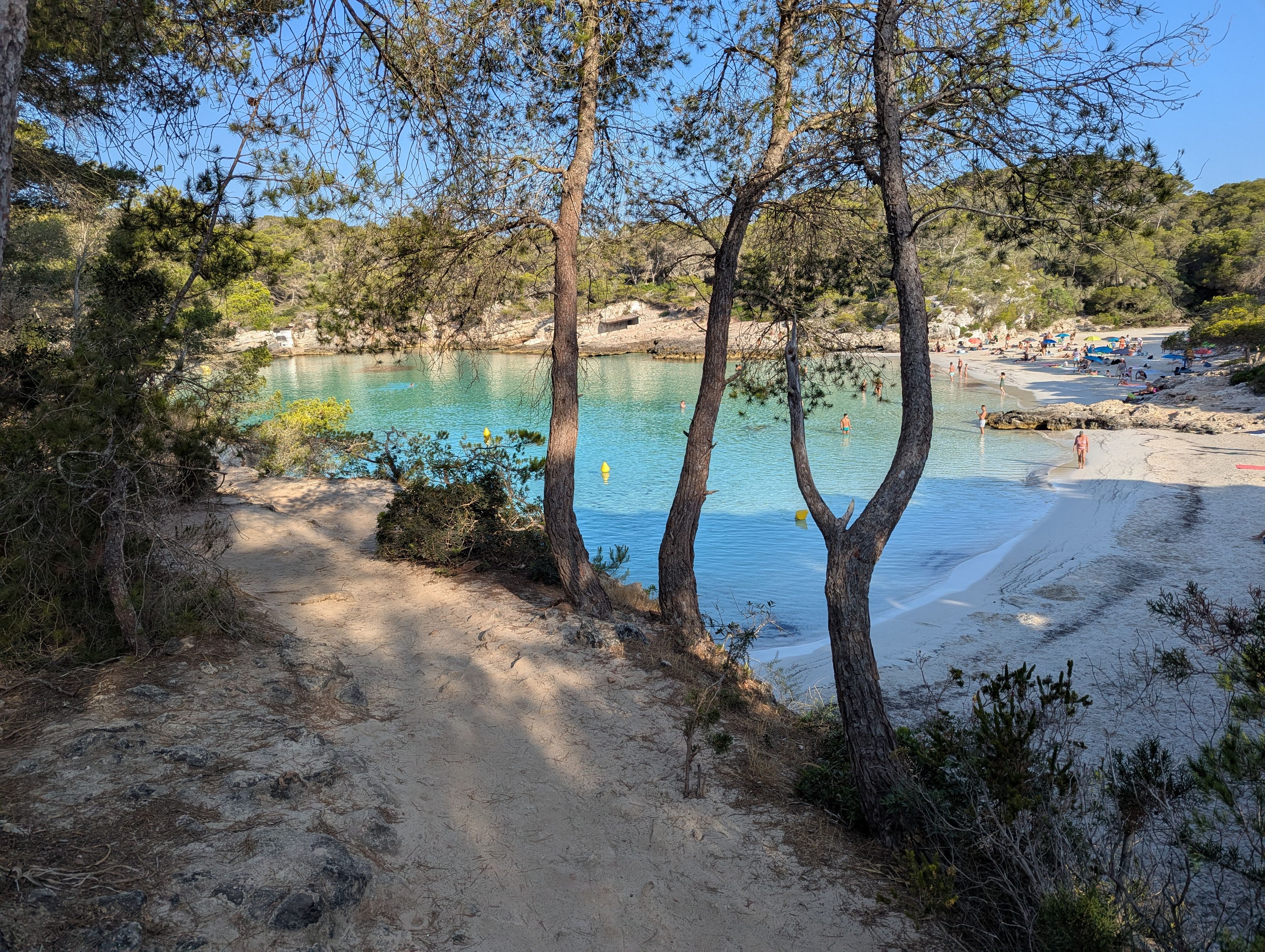
Cala Mitjana
When the day-trippers leave, Cala Mitjana turns from postcard to conversation.
Cala Mitjana matters because it’s a rare Menorcan cove that still feels like geology doing something intimate—white sand held in place by limestone, pines leaning in, water turning quiet as it deepens.
Most people treat it as a single beach. They don’t notice how the shoreline is really a sequence of small rooms—each one with different light, different sound, different privacy—depending on how far you’re willing to walk past the last towel and the last paddleboard.
Stay long enough and you feel the shift: the cove stops being a scene you consume and becomes a place that asks you to slow your breathing, lower your voice, and listen.
The cove is a corridor, not a destination
Cala Mitjana gets photographed like it’s one perfect frame: a crescent of pale sand, pine green on top, turquoise in the middle. But the real pleasure here is movement—following the coastline until the beach stops performing for the crowd. The easiest trap is to stop where the sand is widest, because that’s where the water looks brightest at noon and where the entry is most forgiving. Stay there and you experience Cala Mitjana as a busy public room. Walk instead. Edge to the right-hand side and you’ll find limestone shelves where the water turns glassy, reflecting the cliff face in broken fragments. Continue toward the headland and the sound changes; the cove muffles the outside world and gives you a more private soundtrack—small waves, insects, the occasional clink of a mask being adjusted. On calm days you can snorkel along the rock and see how the color deepens where the seabed drops, the sand giving way to darker patches and scattered stones. The best part is the hour after most people leave. The beach doesn’t suddenly become empty, it becomes intentional—fewer groups, more couples, more swimmers who linger. You notice the wind easing, the light turning lateral, the cliff shadows stretching like a curtain. Cala Mitjana stops being a place you “did” and becomes somewhere you’re still inside.
You arrive with the midday crowd still bright and restless, salt drying fast on shoulders, the path dusty under your sandals as it drops through pine shade and opens suddenly onto sand the color of bone. The water looks impossible—mint at the edge, then a lucid turquoise, then a darker seam where it falls away. You wade in and the temperature changes by inches, a cool ribbon sliding along your calves. Paddleboards glide past like silent furniture being rearranged. Then you do what most people don’t: you walk. Past the center of the beach, past the photo rock, past the point where conversations get louder… and then thinner. The sound edits itself—fewer voices, more cicadas, the soft slap of water against stone. A faint resin scent from the pines mixes with sunscreen and warm limestone. When the sun starts to lower, the cove’s whites turn cream, shadows sharpen under the cliffs, and the water holds the sky as if it has weight.
The Water
At the shoreline it’s pale mint and almost transparent, the sand brightening it from below. A few meters out it shifts to saturated turquoise, then to a clean, darker blue where the seabed falls away along the rocks.
The Cliffs
The cove is carved into pale limestone—soft-edged cliffs and shelves that catch the sun and throw back a chalky glow. Aleppo pines crowd the rim and lean over the sand, adding a resinous scent and a deep green contrast to all that white.
The Light
Late afternoon is when the cove starts to look dimensional—highlights soften, cliff shadows lengthen, and the water holds richer blues. In the last hour before sunset, the sand warms to cream and the pines read darker, almost ink-like against the sky.
Best Angles
Right-hand limestone shelf
You get the cove’s gradient water color in one sweep, with cliff texture in the foreground.
Left-side curve near the trees
A softer, greener frame—pines and shade give the beach a calmer, more intimate mood.
The headland path above the sand
From slightly elevated ground, the cove reads like a layered bowl—sand, water, cliff, canopy.
Waterline looking back toward the cliffs
For photographers: shoot low so the limestone glow reflects into the water; it makes skin tones and highlights look natural.
Far-right quiet corner at day’s end
The intimate angle—fewer people, more negative space, and the sound of water becomes part of the image.
Bring water and something salty; there are no services on the sand and the walk back feels longer in heat.
Wear proper shoes for the access path and rocky edges—flip-flops are fine on the beach, unreliable on the walk.
Pack a mask and snorkel; the rock margins hold the color shifts (and the interest) that the central shallows don’t.
Take shade seriously: a compact umbrella or hat matters here because the brightest hours bounce off pale sand and limestone.
If you plan to stay late, bring a light layer for the walk out; the breeze can turn cool once the sun drops behind the trees.
Handpicked Stays & Tables
Places chosen for beauty and intention, not algorithms. Each one is worth your time.

Can Alberti 1740 Boutique Hotel
Maó (Mahón)
A refined townhouse stay with quiet courtyards and an unforced elegance that suits Menorca. It’s ideal if you want evenings in the old town after a day of coves and salt.

Vestige Son Vell
Near Ciutadella (rural estate)
A country estate done with serious taste—stone, space, and a sense of hush. It’s the kind of base that makes you linger over breakfast and arrive at the beach later, calmer.

Cafè Balear
Ciutadella
A Menorcan institution for seafood that feels both lived-in and exacting. Go for pristine fish and shellfish, and let the port air reset you after a sandy day.

Sa Pedrera d’es Pujol
Near Ferreries
A countryside table where local cooking leans honest and seasonal. It’s the kind of place that makes you order slowly—cheese, vegetables, grilled meats—and remember you’re on an island.
Leave when your footprints start to blur in the cooling sand and the cove’s last voices are the ones you came to hear.