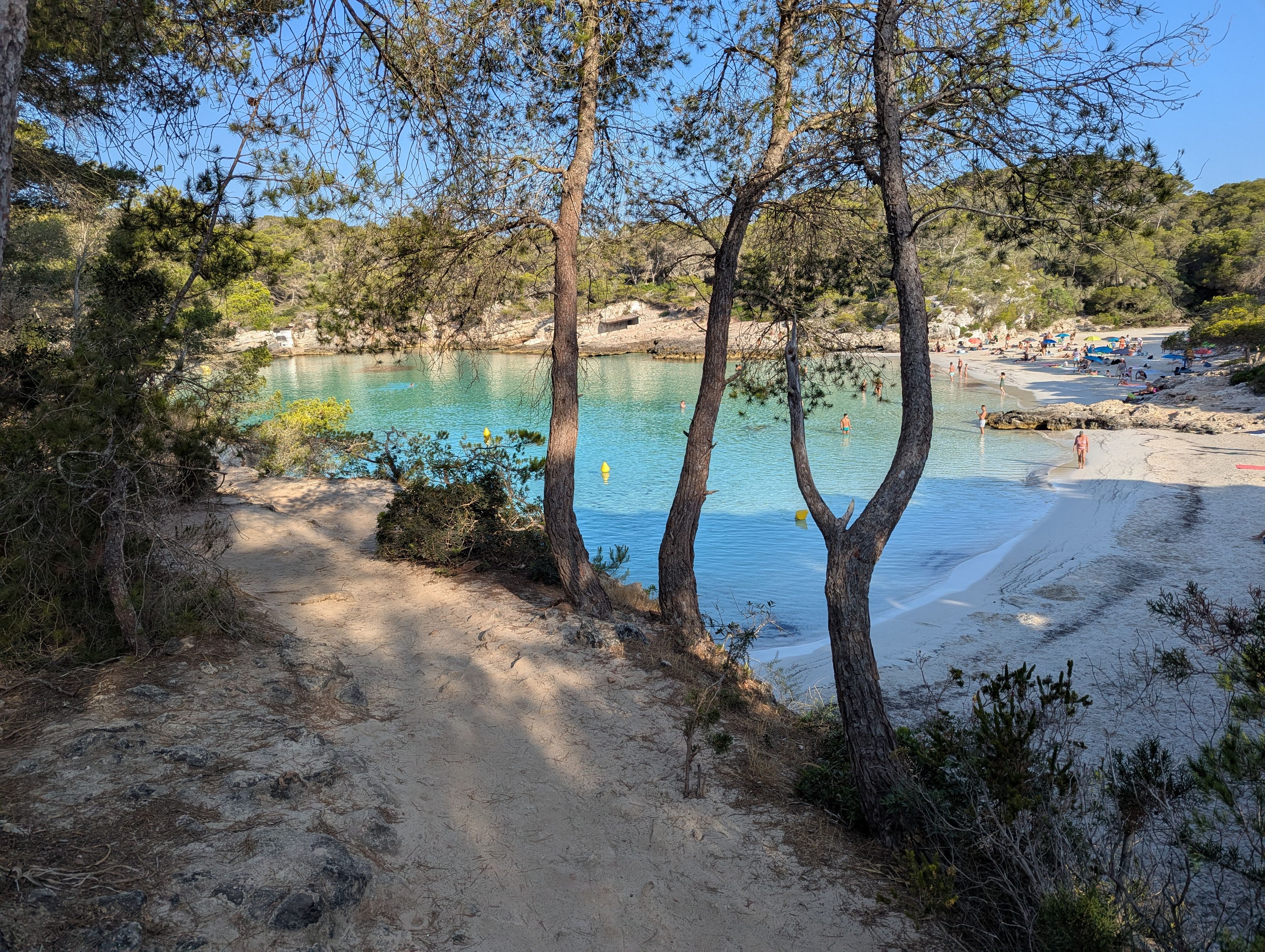
Cala Mitjana
When the north wind lets go, Cala Mitjana’s turquoise stops moving—and starts reflecting.
After a Tramuntana blow, Mallorca feels rinsed—air scrubbed clear, horizons sharpened, the island suddenly quiet in its own skin. Cala Mitjana matters in that brief reset, when the coast looks newly made and you arrive as the sea is still deciding what mood to keep.
Most people come for “blue water” and leave with a photo. What they miss is the transition: the hours after the wind, when the surface turns from chopped glass to actual glass, and every sound—zippers, flip-flops, a gull’s throat—lands louder because the bay stops hissing.
The payoff is a rare kind of calm: not sleepy, not staged… earned. You feel your own pace slow to match the shoreline, as if the cove is teaching you how to breathe again.
The Hour the Bay Becomes a Mirror
Cala Mitjana is often described as a “pretty cove,” which is true in the way it’s true that a good watch tells time. The point is the mechanism. After the Tramuntana blows—dry, insistent, from the north—the sea is aerated and restless, and the whole east coast looks slightly raw. Then the wind drops. Not gradually, but in phases, like someone closing doors inside a house. What changes first is the sound. The surf stops shredding itself on the rocks and starts tapping—small, rhythmic impacts you can count. Then the surface starts to settle from the edges inward. Along the shoreline, the water clears until you can see the sand’s faint ripples, the darker seams where seagrass once lay, the occasional pebble like a punctuation mark. Farther out, the bay becomes a single, unbroken plane, and that’s the moment Mitjana turns cinematic: cliffs and pines double themselves in the reflection, and swimmers seem to hover rather than move. If you time it right, you’re not just “at the beach.” You’re witnessing the coast recalibrate. It’s a different kind of luxury—one based on weather literacy. You leave with salt on your lips and a quieter mind, because the place doesn’t entertain you. It steadies you.
You walk in under pines that smell like warm resin and salt, the path soft with needles, your shoes dusted pale by limestone. The bay opens with a clean, almost startling clarity—two small arcs of sand held in by low cliffs, the color of bone and honey. After the Tramuntana, the air is cool for Mallorca; your skin feels it first, then your ears notice what’s missing: no constant wind-rattle in the branches, no chop on the rocks. The water has that post-storm honesty—transparent at the edges, turning to mint and then a dense, blue-green sheet farther out, like pigment poured into a bowl. Every step into the shallows is audible: sand shifting, pebbles clicking, your breath. You float and look back at the cliff line; it’s not dramatic, it’s precise—layers, cracks, small ledges where scrub holds on. People speak quietly without being told to. Even sunscreen smells sharper. For a moment, Cala Mitjana doesn’t feel like a beach. It feels like a pause button.
The Water
Right after the wind, the water shifts from bright, flecked turquoise to a smoother palette—pale aquamarine at the shore, then a milky mint where sand deepens. Once it fully settles, it reads as glassy jade with a blue core, the kind of color that makes your eyes refocus.
The Cliffs
Cala Mitjana is a limestone pocket—low cliffs, fractured ledges, and scrubby vegetation gripping chalky rock. Pines lean in from above, softening the geometry with green shadow and a constant scent of resin.
The Light
Late afternoon gives you the premium version: warmer rock tones, longer shadows under the pines, and a sea that looks denser and more dimensional. Early morning is cleaner and quieter, but the water often looks flatter until the sun rises higher.
Best Angles
Pine-backed overlook on the approach trail
You get the first full reveal—sand, cliff line, and the layered water gradient in one frame.
Right-hand rocks (facing the sea)
The cove compresses into a more intimate composition, with cliff texture and swimmers against mint water.
Between Mitjana and the smaller adjacent cala
The unexpected angle: a split-scene of two bays, showing how differently each surface settles after wind.
Waterline, knee-deep at the center of the main beach
For photographers: the mirror effect after Tramuntana drop-off turns the cliff and treeline into a clean reflection.
Under the left-side pine shade near the back of the sand
The intimate angle—close details: limestone grains, damp sand patterns, and that soft green light bouncing off the water.
Check the wind forecast, not just the temperature—Tramuntana can make the water choppy and the swim less inviting, then suddenly perfect the next day.
Bring water and snacks; services on-site are limited and the walk back feels longer in afternoon heat.
Wear proper footwear for the approach path and rocky edges—flip-flops are fine on the sand, unreliable on limestone.
Pack reef-safe sunscreen and a light layer; post-wind air can feel cooler, especially in shade under pines.
If you snorkel, go when the surface is calm—the visibility is dramatically better once the bay stops stirring up sand.
Handpicked Stays & Tables
Places chosen for beauty and intention, not algorithms. Each one is worth your time.

Can Ferrereta
Santanyí
A polished, design-forward base in a historic building—quiet courtyards, a serious pool, and a sense of Mallorca beyond the beach loop. You come back from Mitjana and the calm continues, not the opposite.

Ikos Porto Petro
Porto Petro
A refined, sea-facing resort option when you want effortless logistics and a soft landing after salty days. The service is smooth, and the coastal setting keeps you connected to the same light you chase at the coves.

Es Molí de Santanyí
Santanyí
A grown-up, candlelit room in an old mill setting—ideal after a wind-cleansed beach day when you want to eat slowly. Think Mediterranean classics with a little formality and a strong local rhythm.

Norai
Porto Petro
Harbor-side dining with the kind of simple seafood that tastes better because you can still smell the sea. Go near sunset, when boats quiet down and the light turns the water steel-blue.
Come after the wind, when the island stops bracing—Cala Mitjana shows you what stillness looks like in water.