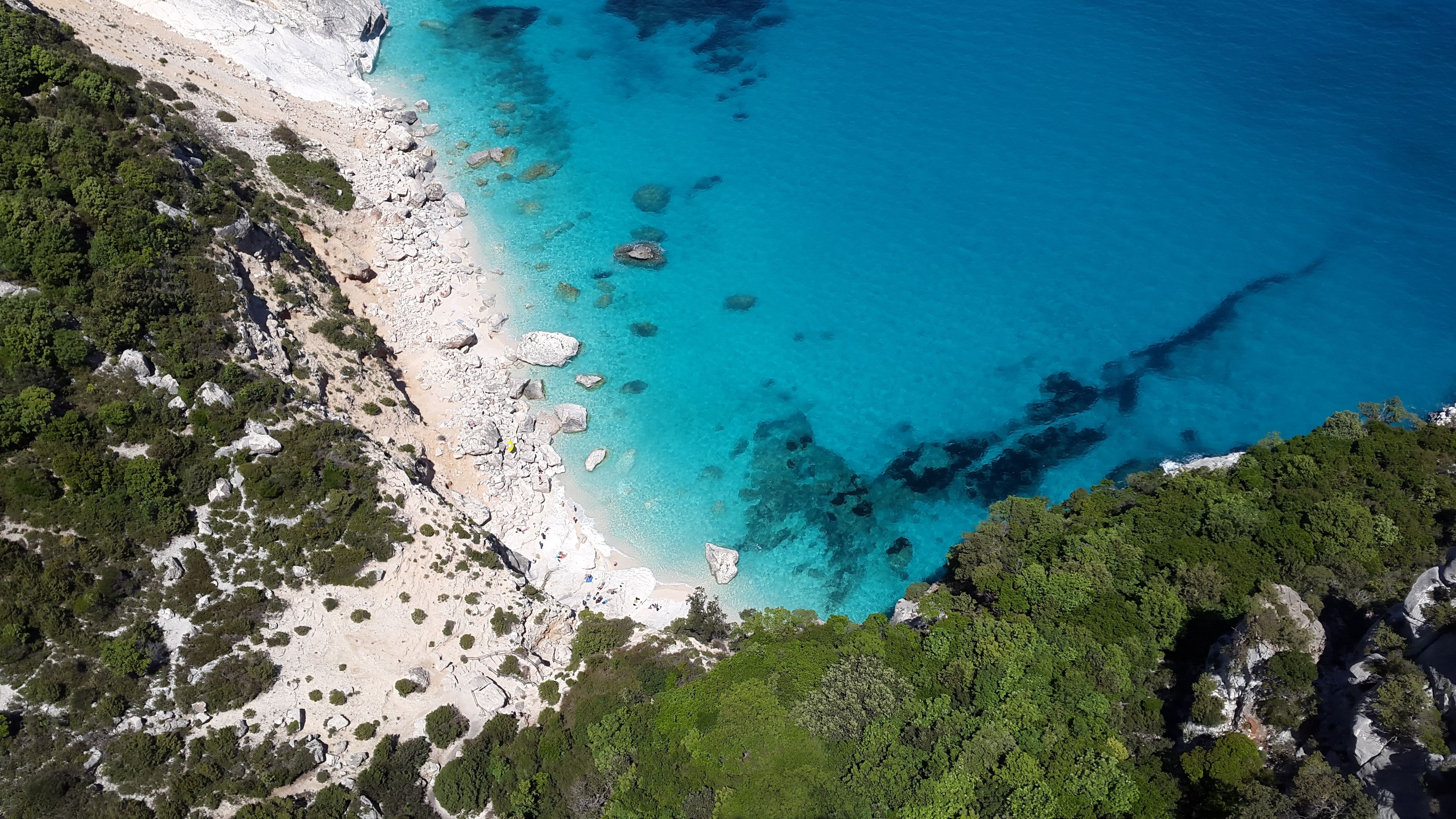
Cala Goloritzé
At Cala Goloritzé, the famous arch isn’t the frame—it’s the threshold.
Cala Goloritzé matters because it makes you earn the color. You don’t arrive by accident—you descend into it, step by step, until limestone turns to pale pebbles and the sea starts flashing turquoise like a signal.
Most people stop at the postcard: the limestone arch and that needle of rock, Punta Caroddi, posed behind swimmers. What gets missed is that the arch behaves like architecture—a carved passage that changes sound, light, and scale when you actually move through it.
When you treat it as a doorway instead of a backdrop, the beach stops being a checkmark. It becomes a small, precise ritual: crossing from the bright, social shoreline into a quieter chamber of water where your breathing slows to match the swell.
The Arch Has Two Seas
From the beach, the limestone arch reads like a prop—an elegant curve you place behind a body and call it a day. But Cala Goloritzé is built on thresholds, and the arch is the most literal one. On the beach side, you’re in the social cove: pebbles bright as bone, water so clear it makes swimmers look suspended, voices carrying easily across the bowl of rock. Swim or paddle to the arch and commit to passing through it. The temperature drops a notch. The surface takes on a faint, metallic sheen where depth arrives quickly. Sound changes too—not silent, but damped, as if the limestone is absorbing the beach’s noise. The rock overhead is textured with pockets and knife-edged lines, and you can see the mechanics of time: fractures, mineral streaks, the grain of the cliff that continues into the sea. This is the point. The arch isn’t a symbol of Cala Goloritzé—it’s a cue. When you step through it, you stop consuming the scene and start inhabiting it. You feel the scale of the coast, the seriousness of the drop-off, the way the Gulf of Orosei doesn’t pose for you. The famous view becomes secondary to the sensation of crossing into water that feels older, deeper, and more real.
You start in heat and dust at Su Porteddu, the air scented with sun-baked maquis—myrtle, juniper, something resinous that clings to your throat. The trail drops fast, gravel skittering under your shoes, and each switchback opens another slice of the Gulf of Orosei—a blue that deepens with every meter you lose. By the time the white limestone walls tighten around the cove, the sound changes: wind fades, voices bounce, water becomes the loudest thing. On the beach, pebbles click underfoot like porcelain. You wade in and the cold catches your ankles, then your knees, clean and bright. Punta Caroddi rises like a stone sail, but your eyes keep drifting to the arch—its curve cut so perfectly it looks designed, not eroded. You swim toward it and the water shifts from transparent mint to a darker, inkier teal. Under the arch the light turns soft, the chatter thins, and the sea feels suddenly private, as if you’ve stepped through a room within the beach.
The Water
Close to shore, the water is a lucid, glassy mint that reveals every pale pebble and the shadow of your legs. Past the shallows it turns electric turquoise, then deep teal near the arch where the seabed falls away and the light thins.
The Cliffs
This is the Gulf of Orosei at its most sculptural: Jurassic limestone cliffs, cut by erosion into ledges, caves, and a freestanding sea arch. Punta Caroddi—the spire you see in every photo—anchors the scene vertically, making the cove feel like a natural amphitheater.
The Light
Late morning gives you clarity: the water reads almost unreal, and the pebble beach glows without harsh contrast. In the late afternoon, the cliff begins to throw shade across parts of the cove, and the arch gains depth—less postcard, more three-dimensional.
Best Angles
Belvedere viewpoint on the Cala Goloritzé trail
You see the whole geometry at once—pebble crescent, arch curve, and the spire rising like punctuation.
Waterline at the right-hand edge of the beach (facing the sea)
The arch aligns with swimmers and gives scale; the limestone reads warm against the cool water.
Under the arch, looking back toward the beach
The cove becomes a framed interior, and the sound/texture shift is visible in the calmer, darker water.
Mid-swim line between the beach and Punta Caroddi
For photographers: you can balance the spire and arch while keeping the water’s gradient in the foreground.
Shallow water near the left side of the beach at ankle depth
The intimate angle: pebbles magnified by the water, ripples turning the surface into moving glass.
Wear proper shoes for the descent and ascent; the path is steep and loose in sections.
Carry at least 1.5–2 liters of water per person in warm months—there’s no shade-based rescue once you’re committed to the climb back.
Bring reef shoes or sturdy sandals for the pebbles; they’re beautiful but unforgiving underfoot.
Pack a mask and snorkel: the water gradient and drop-off near the arch are the whole point from sea level.
Check local access rules and permit requirements in advance, and plan your timing around them.
Handpicked Stays & Tables
Places chosen for beauty and intention, not algorithms. Each one is worth your time.

Lanterna Mandorle
Santa Maria Navarrese
A small, design-forward stay with a calm, coastal palette and a sense of privacy that fits the Ogliastra mood. You’re well placed for early starts to Su Porteddu and late dinners by the harbor.

Hotel Goloritzé
Arbatax (Tortolì area)
Classic resort comfort with pools and sea-facing terraces when you want recovery built into the itinerary. It’s a practical base for the Gulf of Orosei by road and boat, with more services nearby than Baunei.

MeC Puddu's
Santa Maria Navarrese
A reliable address when you want something local after the hike—grilled seafood, simple pastas, and the kind of pacing that lets you come back to your body. Go early or book in summer; the terrace fills fast.

Ristorante Su Gologone
Oliena (day-trip worthy)
More than dinner: it’s a Sardinian statement of hospitality, craft, and ceremony. If you can spare the drive, it’s where you taste the inland counterpoint to Cala Goloritzé’s salt and limestone.
Treat the arch as a passage, and Cala Goloritzé stops being a view you take—it becomes a place you enter.