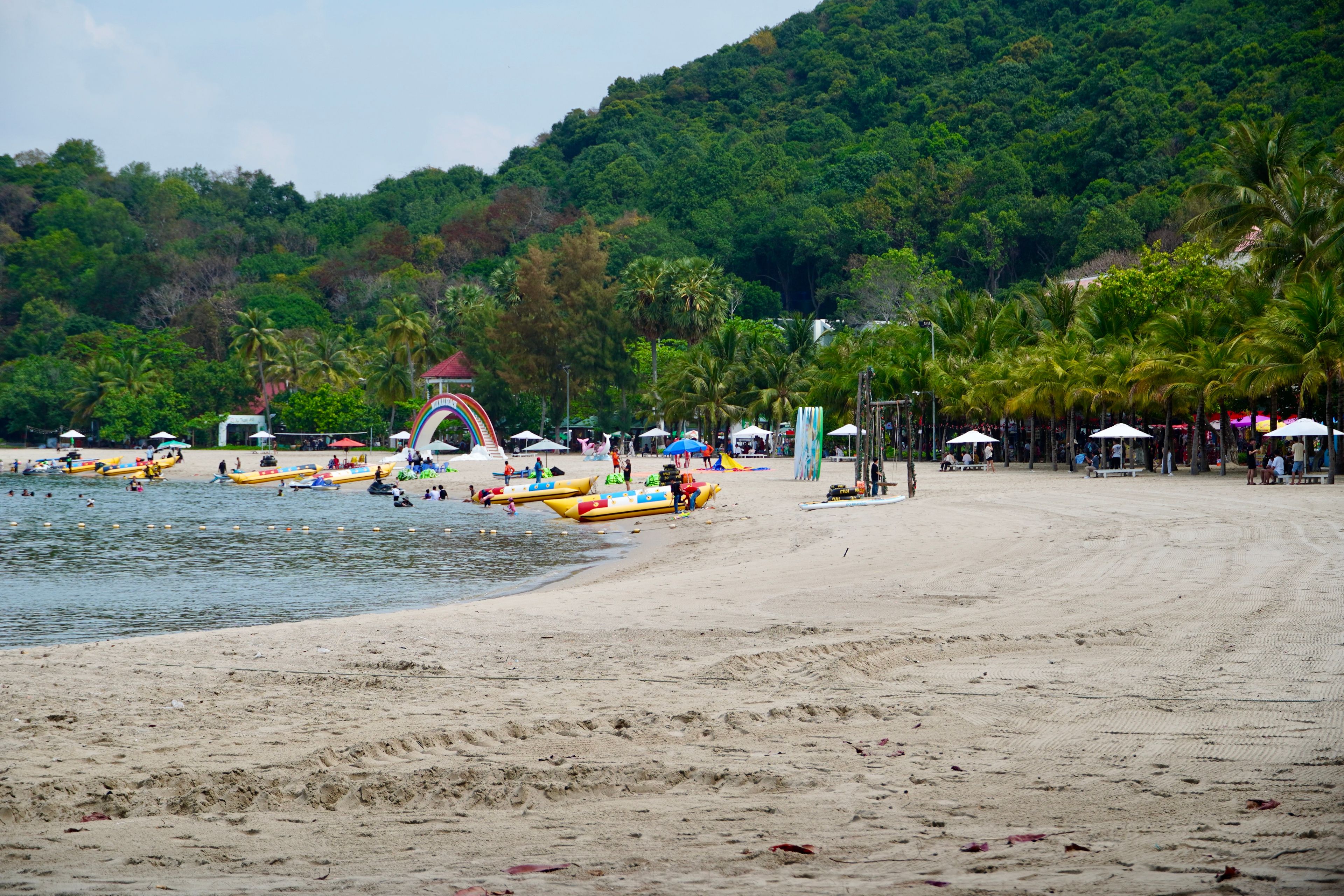
Banana Beach
Slip past the daytime crowd and Banana Beach turns into a hushed study of sea, stone, and shade.
Banana Beach matters because it shows you the Andaman Coast in miniature—one short crescent where Phuket still feels tactile and slow. Even when the island is loud, the bay keeps a softer register: water tapping rock, palms stirring, the small metallic clink of a longtail’s chain.
Most people stop at the first open sand and never look up. The beach is shaped by granite shoulders and a canopy of sea almond and palms, and that shade changes everything—temperature, color, mood, and how long you stay.
When the last longtail noses away and the surface smooths, you feel the place exhale. You stop performing your holiday and start inhabiting it…salt on your forearms, warm sand cooling under the trees, time finally behaving like time.
The Beach Has Two Personalities—And a Switching Point
Banana Beach is famous in the way Phuket fame works: a name passed around by boatmen and day-trippers, then condensed into a single photo—white sand, bright water, a longtail parked at the edge. What most people miss is that the beach isn’t one scene. It’s two, divided by a subtle switching point where the sand narrows and the shade begins. In the middle of the day, the open section is a social space. The light is hard, the water looks almost fluorescent, and the soundscape is busy—engines starting, fins scraping, people calling to each other in a dozen languages. It’s pleasant, but it’s generic Phuket. Walk to the quieter end and you enter the beach’s second personality. The canopy cools your skin immediately. The water under shade looks more mineral than tropical—pale green, glassy, with darker seams where rock and seagrass deepen it. You start noticing the coastline’s architecture: granite worn into soft curves, a small pocket where sand collects, the way the tide leaves a wet, reflective edge that turns the boulders into sculptures. The payoff isn’t that you “found” something. It’s that you gave the place enough time to reveal itself. In that calmer pocket, Banana Beach stops being a stop and becomes a pause—one that stays with you long after you towel off.
You arrive with the sun already high, stepping off the road and down through a short tunnel of green—banana leaves frayed at the edges, pandan scent in the heat. The first glance is bright and busy: pale sand, a few longtails idling, a smear of turquoise beyond the swimmers. But you keep walking, past the easy landing spot, toward the far end where the granite gathers itself into rounded boulders. The noise thins. The water changes color in bands—clear at your ankles, then a milky aquamarine over sand, then deep jade where the rocks drop away. Under the trees the air is cooler, and you hear details again: a gecko clicking, the soft slap of small waves against stone, the hiss of a snorkel breaking the surface. A vendor’s radio fades to nothing. You sit with your back to warm rock, watching the last boat pivot on its rope…then the bay goes still enough to mirror the sky.
The Water
At midday the shallows read as pale, sugary turquoise, almost opaque over fine sand. Later, when the sun lowers, the bay shifts to layered aquamarine and jade, with clear windows where you can see ripples etched across the bottom.
The Cliffs
Banana Beach is framed by Phuket’s rounded granite geology—boulders stacked like slow-motion waves at either end. Behind the sand, a tight band of tropical coastal trees throws real shade, turning the beach into a room with a bright doorway to the sea.
The Light
Late afternoon is when the beach becomes dimensional: shadows lengthen under the canopy and the boulders pick up warm highlights. After a brief rain, the granite darkens and the wet sand turns reflective, doubling the color in the bay.
Best Angles
South-end boulder perch
Climb carefully onto the granite at the quieter end for a clean, curved view of the whole bay—boats, sand, and canopy in one frame.
Waterline at the shade boundary
Stand where sunlight meets tree shade to capture the water’s color shift—turquoise to green—in a single, readable gradient.
Under-canopy back angle
Turn away from the sea and shoot through palm trunks toward the bright water; the contrast makes the beach feel cinematic, not postcard-flat.
Snorkel line along the rocks
From just offshore, aim back at the beach with the boulders in the foreground; it shows scale and keeps swimmers out of frame.
Granite nook at low tide
When the tide drops, small pools form between rocks—perfect for intimate textures: wet stone, trapped light, and miniature reflections.
Bring reef-safe sunscreen and apply it early—there’s shade, but the open sand reflects a lot of light.
Pack water and a small snack; options nearby can be limited or close early depending on season.
Wear sandals or water shoes for the access path and for stepping around the rocks at the ends.
If you plan to snorkel, bring your own mask—visibility is best near the boulders and you’ll want a good seal.
Check the sea state in monsoon months (rougher surf, lower clarity) and avoid climbing wet granite if it’s slick.
Handpicked Stays & Tables
Places chosen for beauty and intention, not algorithms. Each one is worth your time.

Trisara
Near Nai Thon (northwest Phuket)
A private, low-density escape with villas that feel like they were built for sunset. Service is quiet and anticipatory, and the coastline here matches Banana Beach’s calmer mood.

Twinpalms Phuket
Surin area
Design-forward and grown-up, with a strong pool scene and easy access to Phuket’s west-coast beaches. It’s a good base if you want Banana Beach in the afternoon and a polished dinner afterward.

PRU
Trisara, near Nai Thon
Phuket’s flagship for refined, ingredient-driven dining—focused, seasonal, and composed without fuss. Ideal when you want the day to end as thoughtfully as it began.

Catch Beach Club
Bang Tao
A sleek shoreline address for sundowners and seafood, with music that stays on the right side of elegant earlier in the evening. Come for the light, stay for a long, unhurried dinner.
Stay long enough for the boats to leave, and Banana Beach stops posing for you—then it finally starts speaking.