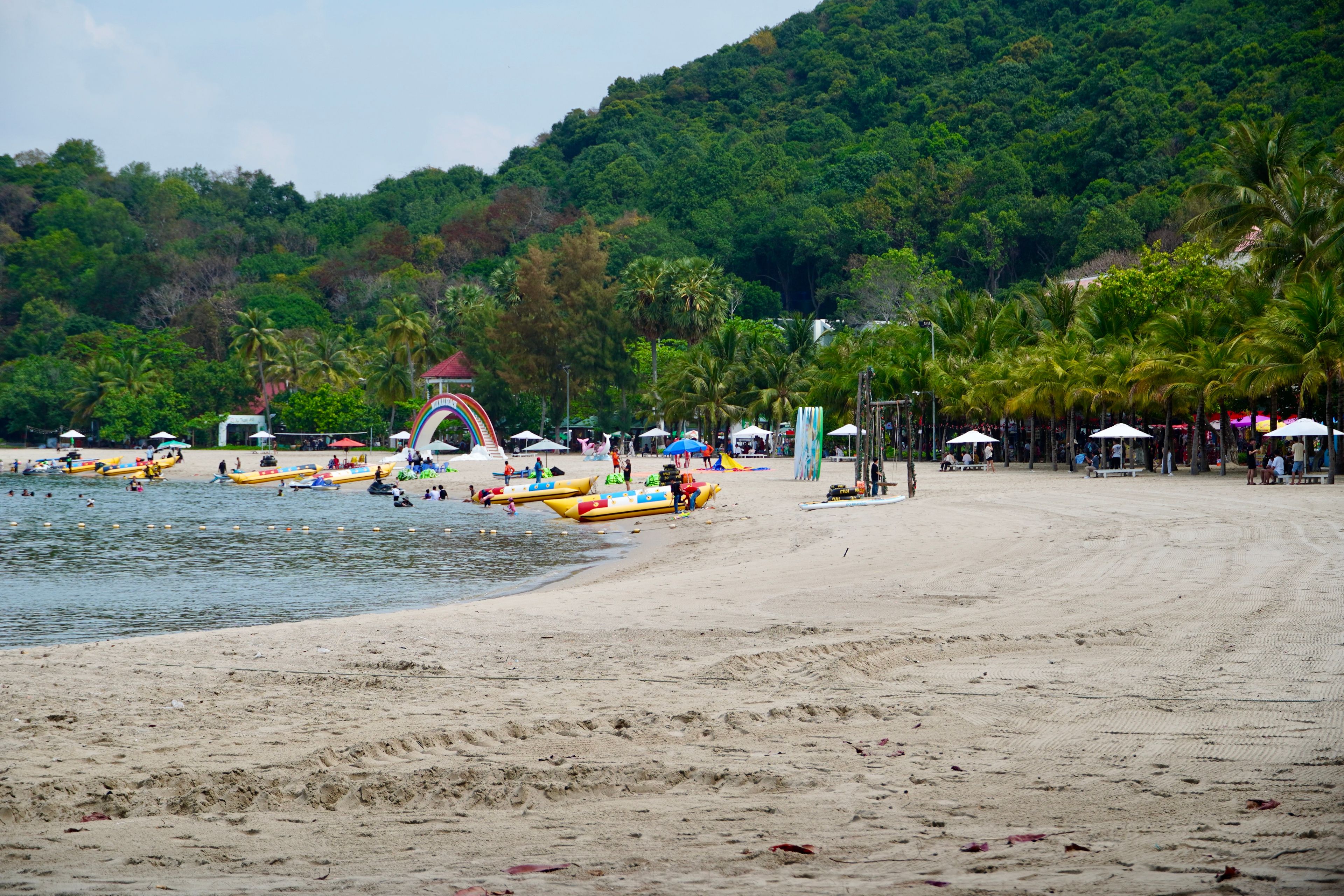
Banana Beach
A few steps past the umbrellas, the reef edge rewrites what “Banana Beach” really is.
Banana Beach on Phuket’s northwest coast matters because it still lets you feel the island’s older rhythm—salt on skin, casuarina shade, and a shoreline that changes mood with the tide rather than with the playlist from a beach club.
Most people stop at the soft sand and the postcard arc. They miss the reef’s seam—where sand turns to coral rubble, where the water suddenly shifts from pale glass to inkier teal, and where the whole beach becomes a living edge.
Follow that line and you stop performing “vacation.” You start paying attention… and the day becomes quieter, sharper, more intimate—like you’ve stepped into the scene behind the brochure.
The Reef Line: Where Banana Beach Turns From Soft to Alive
Banana Beach is sold as sand, but it’s built around a reef. The tell is under your feet: the sand near the middle is fine and obedient, the kind that photographs as “perfect.” Walk twenty meters toward either rocky end and the texture changes—coarser grains, coral flecks, tiny shells. That shift is the beach’s real map. It’s the shoreline’s seam where the reef begins to influence everything: water color, wave shape, even how people spread out. At mid-beach the sea is friendly and open, a shallow bowl where families drift and the horizon is the main attraction. Along the reef line, the water becomes more legible. You see plates of rock and coral rubble just under the surface, and the sunlight starts doing geometry—moving lattices on the bottom, dark pockets where the depth drops. This is where you snorkel without needing drama: mask on, slow kick, and fish appear in the ordinary way they actually live—close to structure, close to shade. The emotional shift is subtle. You stop thinking of the beach as a “place to be” and start treating it as a boundary to follow. It gives you a route, a purpose, a way to step out of the center. In a busy Phuket day, that’s luxury—attention, not excess.
You arrive and the first impression is gentle—an easy crescent of sand framed by dark green trees, the air smelling faintly of sunscreen and warm pine needles from the casuarinas. Longtail boats idle offshore, their engines ticking like cooling metal. You drop your bag where the shade holds, and the beach feels almost too simple… until you walk. At the waterline, the sand gives way to a peppering of coral grains underfoot. The surf is small but purposeful, folding in thin sheets that catch the sun like poured oil. You keep moving toward the far end where the rocks begin, and the sound changes—less chatter, more water working against stone. Now the sea is clearer, and you can read it: a bright, shallow shelf, then a sudden dark band where the reef starts. Small fish flash in the shallows, silver commas against the sand. You pause, knee-deep, and the day narrows to details—ripples, shadows, the slow pull of the tide at the reef edge.
The Water
The water starts as pale jade over sand—almost milky in the shallows, with a silvery sheen when the sun is high. Over the reef line it deepens into clear aquamarine and then a darker teal band, like a brushstroke that marks the drop-off.
The Cliffs
This is Phuket’s northwest in miniature: a sheltered cove, granite boulders at the ends, and a fringe of casuarina and tropical greenery holding the beach in place. The reef sits close enough to shore to shape the surf, so even small waves arrive with a crisp, patterned break.
The Light
Late afternoon gives the beach its most dimensional look—the sand warms to honey, and the reef band becomes more pronounced. Early morning is calmer and cleaner in tone, with fewer footprints and a softer, cooler palette.
Best Angles
South-end boulder shoulder
Climb carefully onto the lower rocks and you get the full crescent—sand, shade line, and the reef’s dark band offshore.
Casuarina shade line (mid-beach)
Shoot from under the trees toward the water for a natural frame—dappled light on sand and a sense of quiet scale.
Reef-edge wade (ankle-to-knee deep)
The unexpected angle is from the water looking back—umbrellas shrink, the beach looks wilder, and the boulders feel more cinematic.
North-end rock shelf at low tide
For photographers: the exposed textures—coral rubble, tide-wet stone, and rippled sand—add foreground detail that makes the scene feel tactile.
Boat line offshore (from the shallows)
The intimate angle is the longtail silhouette against the reef band—especially when the wind drops and the water turns mirror-smooth.
Bring reef shoes or sturdy sandals—the reef-edge walk has coral fragments and slippery rock at low tide.
Pack a mask and snorkel; the best marine life is along the darker reef band near the rocky ends, not the busy center.
Use reef-safe sunscreen and apply it well before you enter the water; the nearshore reef is close and sensitive.
Carry small cash for drinks, snacks, or ad-hoc parking help; card payments aren’t consistent at beach-level vendors.
Check sea conditions before snorkeling—if there’s strong surge or a red flag, keep your swim to the calmer, sandy middle.
Handpicked Stays & Tables
Places chosen for beauty and intention, not algorithms. Each one is worth your time.

Trisara
Layan (northwest Phuket)
A polished, low-density resort where the sea feels curated but not sterile. Private villas, serious service, and sunset views that lean into stillness rather than spectacle.

Anantara Layan Phuket Resort
Layan Beach
Close to Banana Beach without sitting in its foot traffic. Expect spacious rooms, a calm shoreline nearby, and an easy base for early-morning beach runs and quiet departures.

PRU
Trisara, near Layan
A destination table for Phuket that treats ingredients with reverence—clean flavors, beautiful pacing, and a setting that feels removed from the island’s noise. Book ahead and lean into the tasting flow.

Catch Beach Club
Bang Tao
For a more social evening, this is where Phuket’s coastal polish shows up—sunset drinks, a DJ presence, and a crowd that dresses for the light. Go early for a good seat and a softer mood.
If you follow the reef line instead of the crowd, Banana Beach stops being a backdrop and becomes a shoreline you actually remember.