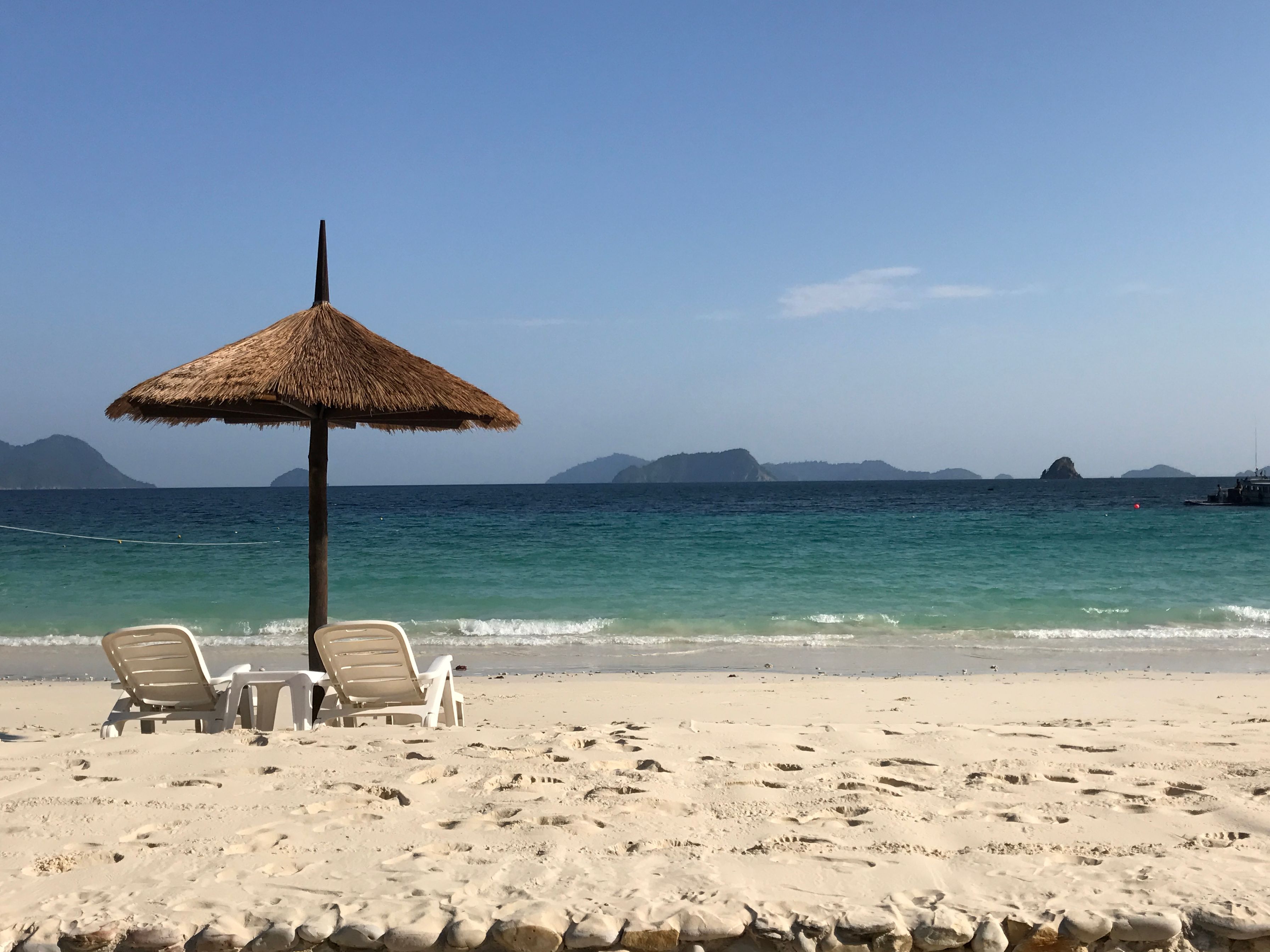
Bamboo Island
A short boat ride from Phi Phi, the sea shifts shade by shade until your ankles disappear into color.
Bamboo Island (Koh Mai Phai) matters because it distills the Andaman into something almost abstract—white sand, low green, and a waterline that reads like a paint sample strip. It is close enough to the Phi Phi bustle to be doable, far enough to feel like you have stepped out of the soundtrack.
Most people treat it as a checkbox: a quick swim, a drone shot, back on the longtail. What they miss is that the island’s real drama happens in the shallows—where the bottom texture, sun angle, and boat shadows create a moving turquoise gradient you can literally walk through.
Stay long enough for the boats to rotate and the noise to thin. The payoff is quiet clarity: you feel your breathing slow as the sea stops performing and starts simply being… and you remember what “rest” actually feels like in your body.
The Gradient Isn’t a Filter. It’s Physics Under Your Feet.
Bamboo Island’s famous color is not one color—it’s a sequence, and the sequence is the point. In the midday rush, you’re tempted to swim straight out to the postcard shade and call it done. But the most revealing place is the in-between: knee-deep, then thigh-deep, where sunlight hits the sandy bottom at a clean angle and the ripples act like tiny lenses. The sea doesn’t just look turquoise; it behaves turquoise, shifting as you move. Stand still and you start to notice how the island is shaped for this effect. The beach shelves gently, keeping you over bright sand for longer. When a cloud passes, the water loses its glow in seconds—then returns even more saturated when the sun breaks again. Boat shadows drag across the shallows like dark silk, briefly “turning off” the color, which makes the next bright band feel almost electric. If you want Bamboo Island to feel less like a stop and more like a place, do one simple thing: stop swimming and start walking. Follow the gradient laterally along the shore, staying in shin-to-knee depth. You’ll feel the temperature change in patches, notice where the sand turns from powder to tiny coral grains, and hear the island’s real soundtrack—wind in casuarina needles, water threading through itself. It’s not about finding emptiness. It’s about finding attention.
You arrive with the engine’s last rasp and the soft slap of hulls settling. The first step off the boat is a small recalibration—warm water, then sand, then that sudden brightness that makes you squint even behind sunglasses. Ahead, the beach is a clean crescent, the sand fine enough to squeak under your soles, backed by a low line of casuarina and scrub that smells faintly resinous in the heat. You wade out and the water changes in bands: clear as glass at your ankles, then a milky aquamarine over rippled sand, then a deeper turquoise where the bottom drops and the longtails hover like insects. Every movement draws a temporary map—your feet cloud the sand, it settles, the color snaps back. Snorkelers float face-down in the distance, their fins flashing neon, while close in you hear only small sounds: the fizz of foam, the click of shells nudged by the tide, the quiet chorus of straps and buckles. You turn, and the island looks improbably simple—just green, white, and an unbroken, luminous blue.
The Water
The water reads in layers: crystal-clear at the edge, then a pale mint where sand is finest, then a saturated turquoise over slightly deeper, rippled bottom. On bright days, the surface throws silver sparks while the underlying color stays steady, like enamel.
The Cliffs
Bamboo Island is low and spare—white sand wrapping a small core of casuarina and coastal scrub. Offshore, the Andaman deepens quickly, so the palette shifts fast from beach-bright shallows to open-sea blue, with longtails and speedboats creating moving punctuation.
The Light
Late morning into early afternoon gives you the most legible gradient, when the sun is high enough to light the sandy bottom without harsh glare. If you stay toward late afternoon, the light warms and the water turns more jade than turquoise, with softer contrast and longer shadows on the sand.
Best Angles
Shallow-walk line along the main beach (shin depth)
It shows the full turquoise gradient in one frame—your foreground stays clear while the color deepens behind you.
North-end curve of the crescent
From here, the shoreline reads as a clean arc, and the anchored boats sit off to the side instead of dominating the scene.
Water-level view facing back to the tree line
The island’s minimal profile becomes the subject—green band, white band, blue band—graphic and calm.
Just beyond the swim zone markers (looking diagonally toward shore)
For photographers: it compresses the shallows into a layered color field and catches swimmers as scale without clutter.
Under-casuarina edge at the back of the beach
The intimate angle—dappled shade, needle litter texture, and a cooler, quieter frame that contrasts the bright water.
Bring reef-safe sunscreen and apply it early; the reflective sand and water will burn you faster than you expect.
Pack your own water and a small snack—services are limited and prices on day-trip stops can be inflated.
Wear water shoes if you plan to explore the edges; sand is soft, but coral fragments and shells can be sharp near transitions.
If you snorkel, keep your fins up in the shallows and avoid standing on coral—this is where the island’s beauty is most fragile.
Carry cash for national park fees and boat arrangements; signal can be inconsistent and card payment is not something to rely on.
Handpicked Stays & Tables
Places chosen for beauty and intention, not algorithms. Each one is worth your time.

SAii Phi Phi Island Village
Laem Tong, Koh Phi Phi Don
A polished, low-rise resort with a long beachfront and enough space to decompress after day-tripping. The setting makes early departures to Bamboo Island feel effortless, and evenings are genuinely quiet by Phi Phi standards.

Zeavola Resort
Laem Tong, Koh Phi Phi Don
Rustic-luxury done with restraint—wood, thatch, and warm service that feels personal rather than performative. It’s a strong base if you want Phi Phi’s nature without the nightlife spillover.

The Beach House Grill & Chill (SAii Phi Phi Island Village)
Laem Tong, Koh Phi Phi Don
Seafood and Thai classics with your feet close to sand, in a setting that leans relaxed rather than scene-driven. Come at golden hour when the light softens and the Andaman looks calmer than it is.

Pad Thai Restaurant (Tonsai Village)
Tonsai, Koh Phi Phi Don
A straightforward, busy local favorite for noodles, grilled seafood, and quick refuels between boats. You eat amid the village hum, which makes the next quiet hour on Bamboo Island feel even cleaner.
Follow the turquoise until it fades into deeper blue, then turn back—Bamboo Island is at its best in the moment you decide to linger.