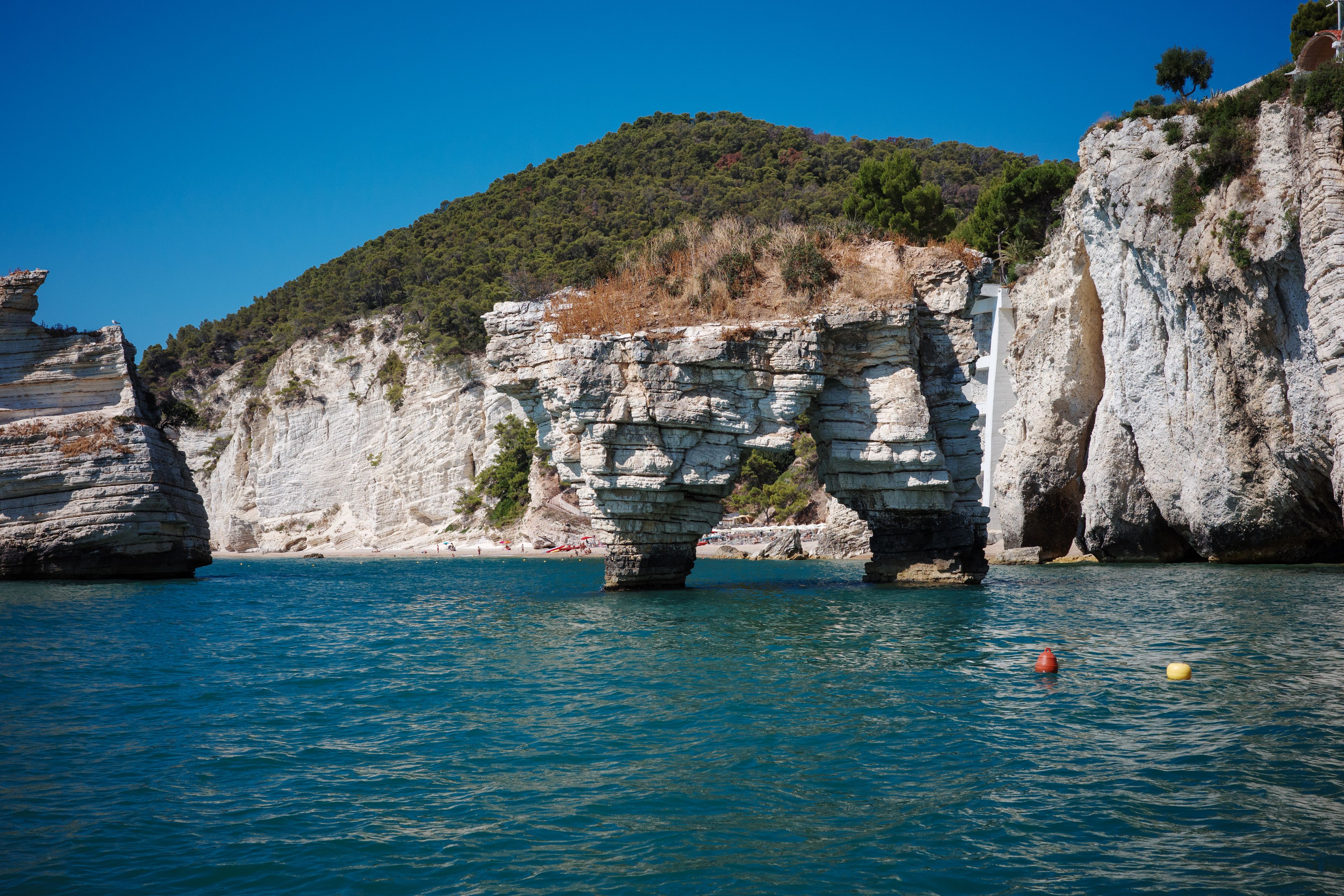
Baia delle Zagare
On a scirocco day, Baia delle Zagare turns from postcard-blue to brushed silver—and feels suddenly intimate.
Baia delle Zagare matters because it proves the Adriatic can be moody—textural, metallic, and cinematic—rather than simply “blue.” Here, the Gargano’s white limestone drops hard into the sea, and the coast feels more like a cliffside amphitheater than a beach day.
Most people come for the sea stacks—the two pale monoliths off the shoreline—and leave with the same photos. What they miss is the way wind changes the entire palette: scirocco haze softens the horizon, the water loses its turquoise certainty, and the cliffs start to glow from within.
The payoff is quiet and oddly personal. In silver light, the bay stops performing. You stop chasing the perfect color and start noticing sound—pebbles rolling under backwash, wind worrying the pines—and you feel the coast’s scale settle into your body.
The Silver Switch: Why Scirocco Is the Bay’s Best Editor
Baia delle Zagare is famous for a certain kind of certainty: clear water, bright limestone, that clean Adriatic line where sea meets sky. On calm days, everything reads instantly—photogenic, legible, almost too easy. But when the scirocco arrives from the southeast, it edits the scene the way a good magazine editor edits a story: it removes the obvious and leaves the meaningful. The haze is the first clue. It slightly erases the horizon, so your eye stops running to the distance and starts reading the near field—the granular surface of the water, the peppering of holes in the sea stacks, the hairline cracks in the cliff. The wind pushes small waves diagonally into the bay, and the sea loses that transparent “vacation” look. It turns reflective, pewter-toned, with sudden flashes where the sun breaks through and strikes a moving ridge. In this mood, the iconic stacks stop being the subject and become scale markers. You notice how tall the cliff really is, how the pine canopy leans, how the beach is narrower than it looks from above. You also notice yourself: shoulders unclench, attention slows. The scirocco can make swimming rougher, yes, but it makes seeing sharper. You leave with fewer perfect photos and a clearer memory—wind in your ears, salt on your lips, and a coastline that feels alive rather than posed.
You arrive with salt already in the air, that warm, faintly dusty breath the scirocco carries across the Adriatic. From the top, the bay looks staged—white cliff, dark green pines, two sea stacks set like punctuation. Then the wind shifts and the water changes first… a sheet of silver with darker seams where waves fold, as if someone drags a brush through molten metal. Down on the shore, the pebbles are cool and pale, and each step makes a soft clatter that vanishes under the surf. The sea stacks sit offshore with a stubborn stillness, their sides chalky and pocked, catching light on the edges and turning almost opalescent when the haze thickens. You taste pine resin when the gusts push inland scent seaward, and you feel the temperature drop a degree as spray lifts and lands on your forearms. People speak more quietly here in this weather. The bay becomes less about color and more about texture—air, stone, water, wind.
The Water
In scirocco conditions the water reads as silver-grey with steel-blue undertones, like polished metal under a thin veil. When sun breaks through, it flashes in narrow bands—bright highlights that move fast across the surface.
The Cliffs
This is the Gargano’s limestone edge—white, vertical, and sharply cut, with Aleppo pines crowning the rim and leaning into the wind. Offshore, the sea stacks rise like broken columns, their surfaces chalky and weathered, a study in erosion.
The Light
Late afternoon is the sweet spot when haze turns the cliffs creamy and the sea stacks pick up rim light. If the scirocco is strong, the hour before sunset is pure cinema—contrast drops, textures rise, and the bay looks sculpted rather than saturated.
Best Angles
Belvedere above Baia delle Zagare (SS89 pull-off viewpoints)
You get the full geometry—cliff, pines, beach, and the two stacks aligned in one frame.
Shoreline looking south toward the stacks
From beach level, the stacks feel monumental and the silver water becomes the foreground story.
Under the cliff edge near the darker rock line at the back of the beach
An unexpected angle where you can frame the bay through shadow and let the bright water flare beyond.
Mid-bay boat perspective (small charter from Mattinata/Vieste)
Best for photographers—low angle, clean separation of stacks against haze, and dramatic cliff height.
Pine-rimmed terrace level at Hotel Baia delle Zagare
The intimate angle—wind in the canopy overhead, cocktails or coffee in hand, and the bay below like a moving metal sheet.
Check wind forecasts (look specifically for scirocco/SE winds). It can elevate the visuals but also roughen the water and limit boat trips.
Bring water shoes—the shoreline is pebbly and the backwash can move stones underfoot.
If you’re not staying at a beachfront-access hotel, plan for a boat approach from Mattinata or Vieste and confirm schedules in advance.
Pack a light layer even in warm months; wind off the water can cool you quickly once you’re wet.
For photos, carry a microfiber cloth—salt spray builds fast in scirocco gusts and softens images.
Handpicked Stays & Tables
Places chosen for beauty and intention, not algorithms. Each one is worth your time.

Hotel Baia delle Zagare
Baia delle Zagare, near Mattinata
A classic cliffside stay with the bay laid out beneath you—pine shade, pale stone, and direct access down to the water. It’s the most seamless way to experience the place without negotiating logistics every day.

La Locanda del Carrubo
Countryside above Mattinata
A quieter base among olive trees, with a more inland sense of the Gargano’s textures—dry stone, herbs, heat. You trade immediate beachfront access for space, calm mornings, and easy drives to multiple coves.

Monte Sant'Angelo Ristorante (Hotel Baia delle Zagare)
Baia delle Zagare
Elegant, sea-facing dining where the real luxury is timing—aperitivo as the water goes pewter, dinner as the cliffs dim to ivory. Expect Puglian staples done with restraint and a view that changes by the minute.

Trattoria da Tonino
Mattinata
A grounded, local counterpoint to the bay’s drama—simple seafood, unfussy service, and a sense of the town’s rhythms. Go for grilled catch, vegetables that taste of sun, and a slower pace than the coast road.
When the scirocco pulls color out of the Adriatic, Baia delle Zagare gives you something rarer than turquoise—attention.