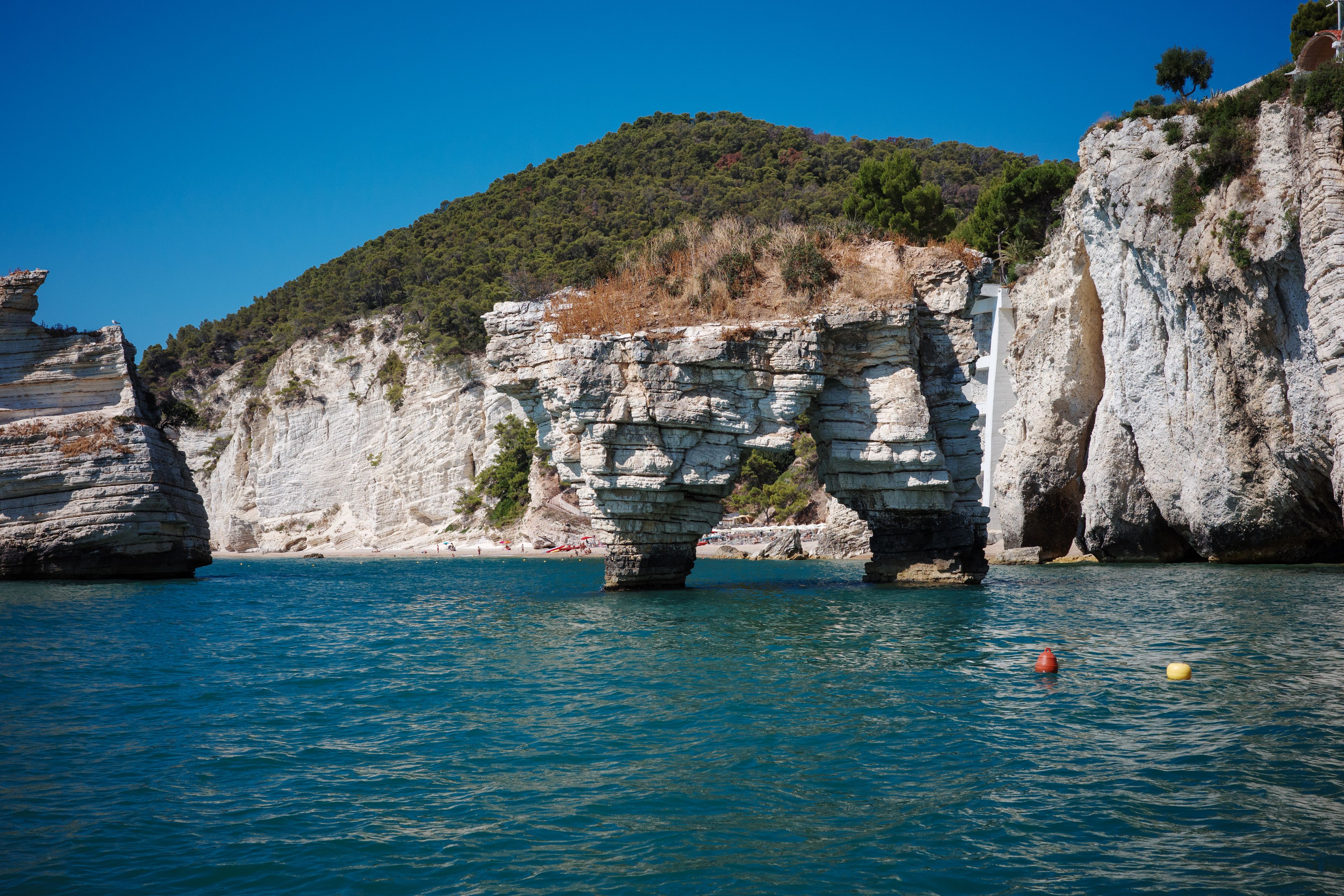
Baia delle Zagare
You don’t arrive at Baia delle Zagare—you drop from pine shade into blinding limestone and sea.
Baia delle Zagare matters because it’s one of the few places on Italy’s Adriatic where the land still feels in charge—white cliffs, stubborn pines, and those impossible sea stacks standing like punctuation in the surf. You feel the scale before you see the beach, as if the coast is asking you to slow down and earn it.
Most people treat it as a postcard: a quick look at the Faraglioni, a photo, a swim. What they miss is the arrival itself—the way the forested plateau above holds back the view until the last seconds, and how that delay changes what you notice once you’re down on the shingle.
The payoff is quiet and physical. You step out of green shade into salt-bright air, and the day rearranges itself around simple things—light on stone, the temperature of the water, the sound of pebbles moving under each wave.
The Forest Is the Frame, Not the Background
Baia delle Zagare is famous for what sits offshore—the Faraglioni, those chalky sea stacks that make every phone camera behave. But the real composition starts above you, in the pine belt on the cliff-top. Arriving from that forest changes your eye. You go from soft, green shade to a white, reflective world where every surface amplifies the day. That contrast is not just pretty; it’s a sensory reset. Your pupils tighten, your skin warms, and suddenly you understand why this bay feels theatrical without being artificial. Most visitors come by boat or see it from the road and think the drama is the rock formations. On the beach, the overlooked detail is the soundscape: the Adriatic here isn’t a constant hush. The pebbles create a percussive rhythm—each wave pulls stones back with a dry, granular rattle. It’s intimate, almost like hearing the place breathe. And because the bay is hemmed in by cliffs, the sound rebounds. You’re inside an amphitheater of limestone. Stay long enough and you notice the color logic. The water near the stones turns milky-green from reflected cliff light; farther out it deepens quickly. When the sun slides west, the stacks stop looking like symbols and start looking like mass—weight and shadow. The descent teaches you to read Baia delle Zagare as a sequence, not a snapshot.
You start in the Gargano’s high, resin-scented calm—Aleppo pines, dry needles underfoot, the air cooler than you expect for Puglia. The path feels almost ordinary until it begins to tilt, then tighten… and the horizon appears in fragments between trunks: a strip of Adriatic blue, then nothing, then blue again. Your ears get there first—wave noise rising, the click and drag of pebbles being sorted by the sea. As you descend, the light hardens. Limestone flashes through the greenery like bone. Then the coast opens, sudden and complete: pale cliffs dropping straight into water that shifts from jade near shore to ink farther out, with the Faraglioni stacks set offshore like sculpted accidents. On the beach, the stones are warm and smooth, uncomfortable for a second, then strangely grounding. You taste salt on your lips before you swim. Even the umbrellas—if you’re in the serviced section—feel temporary against the permanence of rock and tide. You look up and realize the forest is watching from above.
The Water
Near the shoreline, the water runs pale jade with a faint chalky opacity, lit from below by the shingle and the white cliff face. A few strokes out, it shifts to a cleaner aquamarine, then drops into a deeper Adriatic blue that reads almost velvety in calm conditions.
The Cliffs
This is the Gargano’s limestone coast at its most graphic—sheer, pale walls with pockets of pine and scrub clinging wherever they can. Offshore, the Faraglioni rise as detached remnants, shaped by erosion and wave force, their bases darkened by constant wetting.
The Light
Late afternoon is when the bay looks most dimensional: the cliff face softens from stark white to warm cream, and the sea stacks finally hold shadow. Early morning is quieter and cooler, with cleaner color separation between greens of the pines, whites of the rock, and blues of the water.
Best Angles
Belvedere above Baia delle Zagare (SP53 viewpoint pull-off)
You get the full geometry—cliff arc, shingle ribbon, and the Faraglioni aligned offshore for a classic wide composition.
Stair descent switchbacks through the pines
Shoot downward through trunks and needles; the sea appears in slices, turning the arrival into a visual story rather than a single reveal.
Waterline at the north end of the beach
From low angle, the cliff reads taller and the pebbles catch light, giving texture that most photos miss.
Boat-level view just outside the bay (small charter from Mattinata or Vieste)
The stacks feel monumental from the water, and you can frame the entire bay as a limestone crescent with pine crown.
Under-cliff edge where shade meets sun (late afternoon)
The transition line creates natural contrast—cool shade tones against sunlit water—ideal for intimate portraits and detail shots.
Bring water shoes—the shingle is beautiful but unforgiving, and the entry can be slippery where pebbles shift under the waves.
Check access rules before you commit; some entrances are tied to the adjacent hotels or beach concessions, and policies change by season.
Pack light for the descent and ascent; even a short stairway feels longer in midday heat, especially with wet towels and bags.
If the sea is choppy, expect stirred-up color near shore; for the cleanest water tones, go after a calm night or early morning.
Carry cash or a card for beach service if you plan to rent a sunbed/umbrella—availability can be limited in peak months.
Handpicked Stays & Tables
Places chosen for beauty and intention, not algorithms. Each one is worth your time.

Hotel Baia delle Zagare
Baia delle Zagare (near Mattinata, Gargano)
You stay on the cliff with direct access down to the bay, which changes everything—your day begins with the descent, not a drive. Expect classic resort comforts, sea-facing terraces, and a front-row relationship with the Faraglioni.

Hotel Residence Il Porto
Mattinata
A calmer base in town with the practical advantage of walkable meals and an easy starting point for coastal drives and boat trips. It’s less about staged views and more about having space, parking, and flexibility on the Gargano.

Ristorante Monte Barone
Mattinata
A reliable address for local Puglian cooking when you want something grounded after a salt-heavy day—grilled seafood, pasta, and vegetables that taste like the region’s sun. Service is warm, and the pace encourages you to linger.

Trattoria da Antonino
Mattinata
Straightforward, satisfying, and tuned to what you crave after the beach: simple seafood, honest portions, and a casual room that doesn’t ask you to dress up. Go early in high season if you don’t like waiting.
When you climb back into the pine shade, the sea stays behind your eyes—bright, loud, and impossibly white-edged.