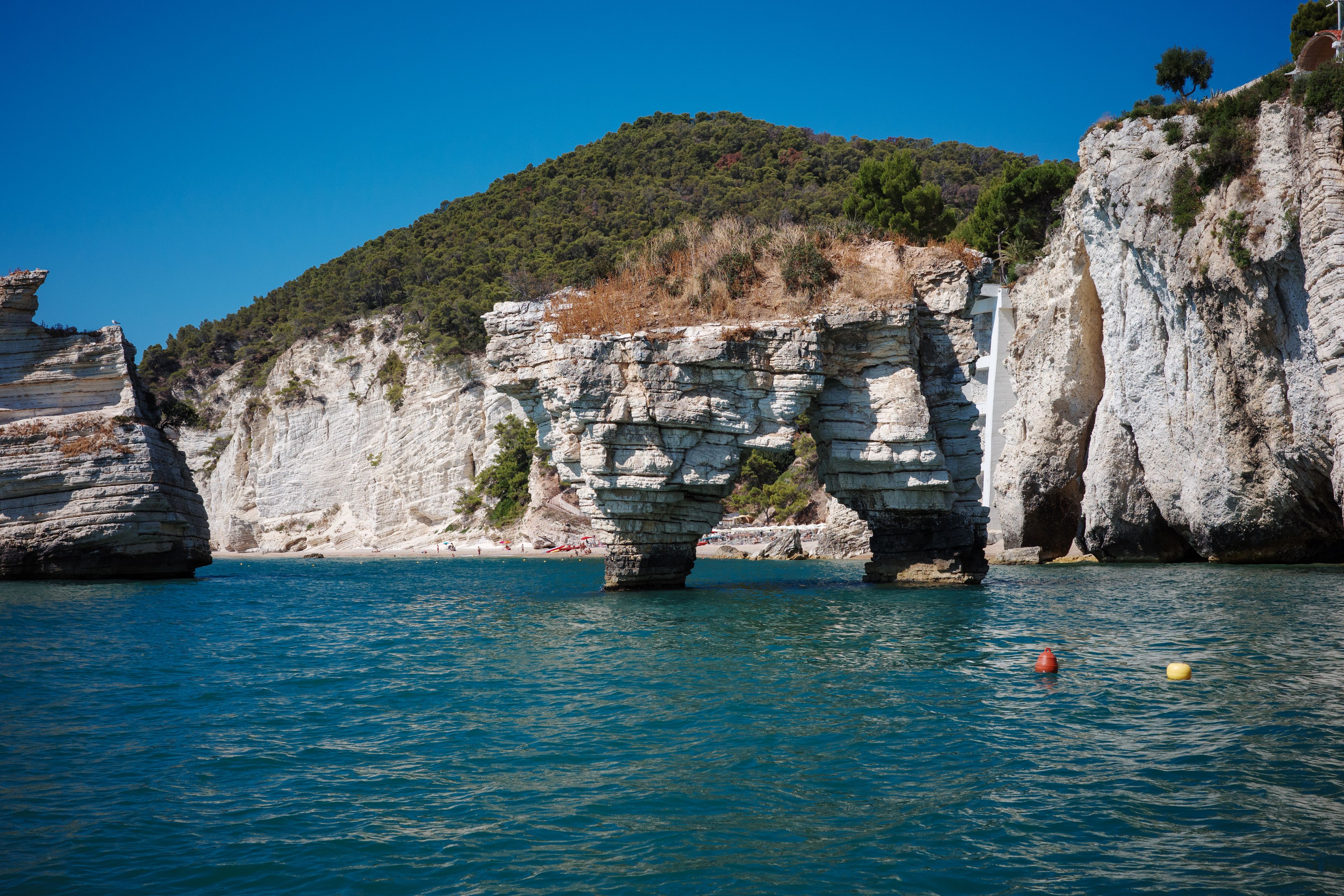
Baia delle Zagare
At Zagare, the headline sea stacks are only the beginning—watch how the cliffs and light do the real talking.
Baia delle Zagare sits under the white limestone wall of the Gargano like a held breath—quiet, vertical, and intensely Mediterranean. You come for the famous frame of two sea stacks in pale water, but what stays with you is the sensation of being watched by the cliff: stratified rock, wind-scrubbed shrubs, and a sea that changes tone every few minutes.
Most people stop at the postcard viewpoint and miss the bay’s grammar—the caves that open and close depending on swell, the way the pebbles shift color when wet, the falling light that slides down the cliff face like fabric. Zagare isn’t a single view; it’s a sequence.
When you let it unfold, the reward is intimate rather than triumphant. You feel small in a calming way, tuned to minor sounds—the click of stones, the soft collapse of foam—and you leave with your eyes recalibrated to subtler beauty.
The Bay’s Real Landmark: The Moving Edge Between Rock and Sea
Baia delle Zagare is photographed as a fixed composition: two sea stacks, a ribbon of pale beach, a cliff that behaves like a backdrop. But the bay’s real landmark is mobile—the thin border where water meets stone, and the way it rewrites the place all day. The pebbles here are not decorative; they are an instrument. Dry, they read as matte and pale. Wet, they deepen to smoky grays and warm creams, and the entire shoreline darkens by a shade, as if someone lowers the exposure. That change is what makes the water look impossibly clear—your eye is comparing the luminous shallows against a newly darkened “frame” of stones. Then there are the caves and scoops in the cliff line. They do not announce themselves from the viewpoint above. Down at beach level, you notice openings that feel temporary, revealed when the sea smooths out and erased when it gets restless. The cliff face catches light in planes, not one wash—morning highlights the upper ledges; later, the sun drops and the brightness slides downward, leaving the top in a clean, theatrical shadow. If you time it right, you end up doing what Zagare quietly asks: watching, not collecting. The bay becomes less about the iconic stacks and more about the sensation of change—proof that this coast is alive, not posed.
You arrive on the Gargano road with salt already in the air, then the land drops away and the bay appears in fragments—first a sliver of blue, then the chalky cliff, then the two stacks standing offshore like punctuation. The descent feels like stepping into a cooler register of sound: cicadas fade, and the beach takes over with the dry rattle of pebbles underfoot. The water is clearer than you expect, not a flat turquoise but layered—glass near the shore, then a milky aquamarine where the stones lighten the shallows, then cobalt where the bottom falls away. When a small set of waves comes through, the beach speaks in clicks and shuffles; when it retreats, it leaves a sheen that turns every stone into a polished bead. You look back and the cliff is not just “white” but veined—cream, bone, and faint honey where moisture sits. As the sun shifts, shadows from the stacks lengthen across the surface, and the whole bay becomes a slow-moving study of contrast.
The Water
The water reads in layers: transparent at the lip, then a pale aquamarine where pebbles brighten the shallows, then a saturated blue beyond the drop-off. On calm days, the surface takes on a glassy, slightly silvery sheen that makes the stacks’ shadows look inked in.
The Cliffs
This is Gargano limestone—high, pale cliffs with visible strata, undercut in places by wave action and punctuated by cavities and small grotto-like recesses. The sea stacks offshore feel like fragments of the cliff that stayed behind, their edges softened and chalky against the deeper water.
The Light
Late afternoon is the signature: the light warms the cliff from bone-white to creamy gold, and shadows become long enough to add depth to the rock texture. Early morning is quieter and cooler in tone—more crisp contrast, fewer people, and a calmer sea that makes the shallows read like cut glass.
Best Angles
Panoramic turnout on SP53 (Baia delle Zagare viewpoint)
It delivers the classic geometry—cliff, beach, and the two stacks aligned—without the visual noise of umbrellas.
Beachline facing north toward the cliff’s undercuts
You trade the postcard for texture: strata, small caves, and the way shadows carve the wall into planes.
Shoreline at water’s edge, looking back toward the pebbles
The unexpected angle is downward—wet stones become a mirror and make the water’s clarity feel almost unreal.
Offshore by kayak or pedal boat, level with the stacks
For photographers, this flattens the scale into a minimalist seascape—stacks, horizon, and a clean band of color.
Far end of the beach near the quieter access points
The intimate angle is human-scale: fewer voices, more wave sound, and a softer view where the cliff feels protective rather than monumental.
Confirm beach access logistics before you drive—some entrances are controlled by hotels or lidos, especially in high season.
Wear water shoes: the pebbles are beautiful but unforgiving, and the shoreline can be slippery where stones are algae-slick.
Bring a small dry bag and minimal gear if you plan to move along the waterline or rent a kayak—spray arrives suddenly near the rocks.
Skip heavy snorkeling expectations on windy days; visibility drops fast when the pebbles churn and the water turns milky near shore.
Pack shade or plan for it: the cliff throws limited, shifting shadow, and midday sun reflects hard off pale stone and water.
Handpicked Stays & Tables
Places chosen for beauty and intention, not algorithms. Each one is worth your time.

Baia delle Zagare (Hotel & Resort)
Near Mattinata, overlooking Baia delle Zagare
You stay for the privilege of proximity—private access and the ability to see the bay in early and late light, when it feels most itself. Rooms lean resort-classic, but the real luxury is the morning quiet and the cliff-framed sea below.

La Locanda del Carrubo
Mattinata countryside
An intimate base among olive trees, with a slower, rural Gargano mood and a short drive to the coast. It suits travelers who want Zagare as a highlight, not a full-time scene, and who value calm evenings over beach bustle.

Monte Sant'Angelo (day trip for classic trattorie)
Monte Sant'Angelo
Go up into the hills when you want a break from salt and sun—stone streets, cooler air, and hearty Gargano cooking. Choose simple kitchens that do local pasta, grilled meats, and vegetables that taste like they were picked that morning.

Vieste waterfront seafood spots
Vieste
For a post-beach reset, Vieste gives you that sea-facing table energy without trying too hard. Order what’s local and straightforward—grilled fish, crudo when it’s pristine, and something citrusy to match the coastline’s brightness.
When you stop treating Zagare like a single photograph, the bay answers back—stone by stone, shadow by shadow, wave by wave.