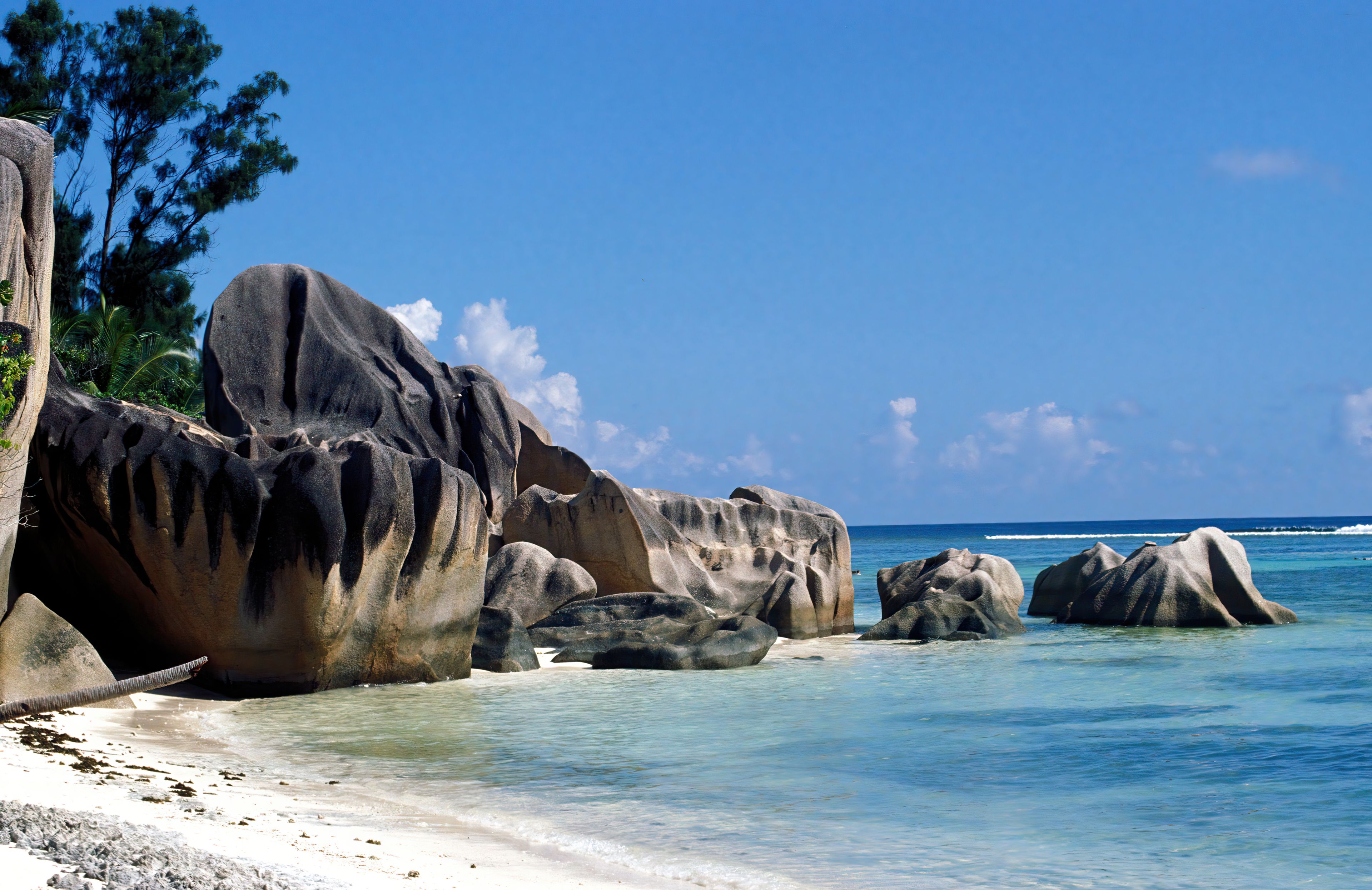
Anse Source d’Argent
Walk beyond the famous boulders and the beach changes tone—quieter, saltier, more intimate.
Anse Source d’Argent is the image people carry of the Seychelles—granite the color of warm ash, water like poured glass, sand as pale as sifted flour. But what makes it matter isn’t the postcard. It’s how quickly the scene can turn from performance to presence if you keep walking, letting the landmark rocks fall behind you.
Most visitors stop where the boulders look most dramatic and the cameras pile up. They miss the way the beach is actually a sequence of small rooms—coves stitched together by ankle-deep channels, sea-grape shade, and narrow passages where granite pinches the shoreline into a private corridor.
Past the last rock, you feel the island exhale. The sound changes first—less chatter, more rinse-and-return of the tide—then your body does. Your shoulders drop. Your pace becomes tidal. You stop collecting the place and start inhabiting it.
The Beach Is a Series of Rooms, Not One View
Anse Source d’Argent is often treated like a single set piece: one famous cluster of granite, one shallow lagoon, one perfect photograph. But the truth is more intimate—this beach is designed by geology to be experienced in chapters. The granite doesn’t just decorate the shoreline; it edits it. Boulders form thresholds, and each threshold changes what you hear, how you move, and who stays with you. In the busiest central pocket, the light is loud—white sand throwing it back at you, water reflecting it upward onto faces and rock. It’s beautiful, but it’s also a stage. Walk on, and you notice the small things the stage distracts you from: the way the sand turns slightly coarser where the tide runs faster, the way seaweed gathers in neat commas after a night of swell, the way the lagoon’s surface becomes faintly rippled where the breeze has a clear line in. Past the last dramatic rock, the beach loses its signature silhouette—and gains its mood. You start reading the place by texture instead of spectacle: granite that feels cool in the shade, coral fragments that click softly under your steps, water that turns from turquoise to a silvery green when a cloud passes. This is where you stop trying to own the view. You simply let the island arrange you—slower, quieter, and more present.
You enter through L’Union Estate with dust on your sandals and the soft, sweet smell of vanilla and frangipani in the heat. The path opens and the first boulders appear—giant, rounded forms stacked like slow-motion waves, their surfaces stippled and warm to the touch. In front of them, the lagoon holds its breath: shallows that shift from milky mint to clear aquamarine, then deepen into a strip of cobalt beyond the reef. You wade in, water sliding over your shins, and hear the gentle percussion of coral sand underfoot. For a while, you’re part of the choreography—people edging into frames, the sun bouncing off phone screens, guides pointing toward the “right” rock. Then you drift left, then further, following the curve where the granite begins to thin out. The beach narrows, the crowd dissolves, and the wind carries only salt and the faint green scent of sea-grape leaves. In the quieter coves, the island feels less like a destination and more like a room you’ve been allowed into.
The Water
Inside the reef, the water reads like layered glass—pale jade in the shallows, then a clean aquamarine that turns almost transparent over sand. Look outward and the color snaps darker, a deep marine blue where the reef edge begins and the Indian Ocean takes over.
The Cliffs
These granite boulders are ancient and weathered into soft, improbable curves, their surfaces salted and pitted like skin. The beach is backed by sea-grape and low coastal vegetation, with the reef acting as a breakwater that keeps the lagoon calm and luminous.
The Light
Early morning gives you the most nuanced palette—cooler tones in the granite, fewer harsh highlights on the sand, and calmer water that photographs like a mirror. Late afternoon can be stunning too, when the sun drops lower and the rock faces pick up warm, honeyed edges, but contrast increases fast.
Best Angles
The central granite corridor (main cove)
This is the classic frame—boulders creating a sculptural gateway with a bright lagoon beyond. Arrive early to avoid bodies in the negative space.
Leftward walk toward the quieter coves
As the granite thins, your composition becomes more minimal—long shoreline curves, softer rock forms, and fewer visual distractions.
The narrow pass between boulders (mid-beach pinch point)
You get a sense of scale here—granite towering close on both sides, with a sliver of water pulling your eye through like a hallway.
Shallow-water, knee-deep perspective facing the reef
For photographers, the lagoon becomes your foreground—ripples, sand patterns, and reflections add depth while the boulders anchor the horizon.
Sea-grape shade at the back of the beach
The intimate angle: filtered light, quieter color, and details—salt on rock, leaf shadows on sand—when the sun gets too hard.
Bring small cash or a card for L’Union Estate entry and keep your ticket accessible for checks on the path.
Wear water shoes or sturdy sandals if you plan to explore around the rocks—coral fragments and slippery patches appear near the edges.
Pack reef-safe sunscreen and something for shade; the reflective sand makes the sun feel more intense than the air temperature suggests.
Aim for a moderate tide: too low can expose more coral debris; too high can squeeze the beach and reduce the walkable coves.
If you’re cycling from La Passe, lock your bike and carry a light layer for the ride back—late-afternoon breezes can feel cooler once you’re wet.
Handpicked Stays & Tables
Places chosen for beauty and intention, not algorithms. Each one is worth your time.

Le Domaine de L’Orangeraie Resort & Spa
Near La Passe, La Digue
A polished, adults-leaning retreat with a strong sense of calm—wood, stone, and tropical planting that feels intentional rather than showy. It’s well-placed for sunrise beach runs and quick rides to Anse Source d’Argent.

Le Nautique Luxury Waterfront Hotel
La Passe waterfront, La Digue
Small, contemporary, and breezy, with sea-facing rooms that keep you connected to the island’s rhythms. You’re minutes from the jetty and perfectly positioned to cycle out early before the beach becomes a meeting point.

Combava Restaurant (Le Domaine de L’Orangeraie)
La Digue
A refined Creole-leaning menu with careful plating and a setting designed for long, unhurried dinners. Come for fresh fish and sauces that actually taste of the island—citrus, herbs, and heat used with restraint.

Fish Trap Restaurant
La Passe, La Digue
A dependable waterfront choice when you want seafood without ceremony. The best seat is outdoors near dusk, when the harbor light softens and you can feel the day’s salt still on your skin.
When you keep walking past the last rock, the famous view fades—and what’s left is the sound of water doing what it has always done here.