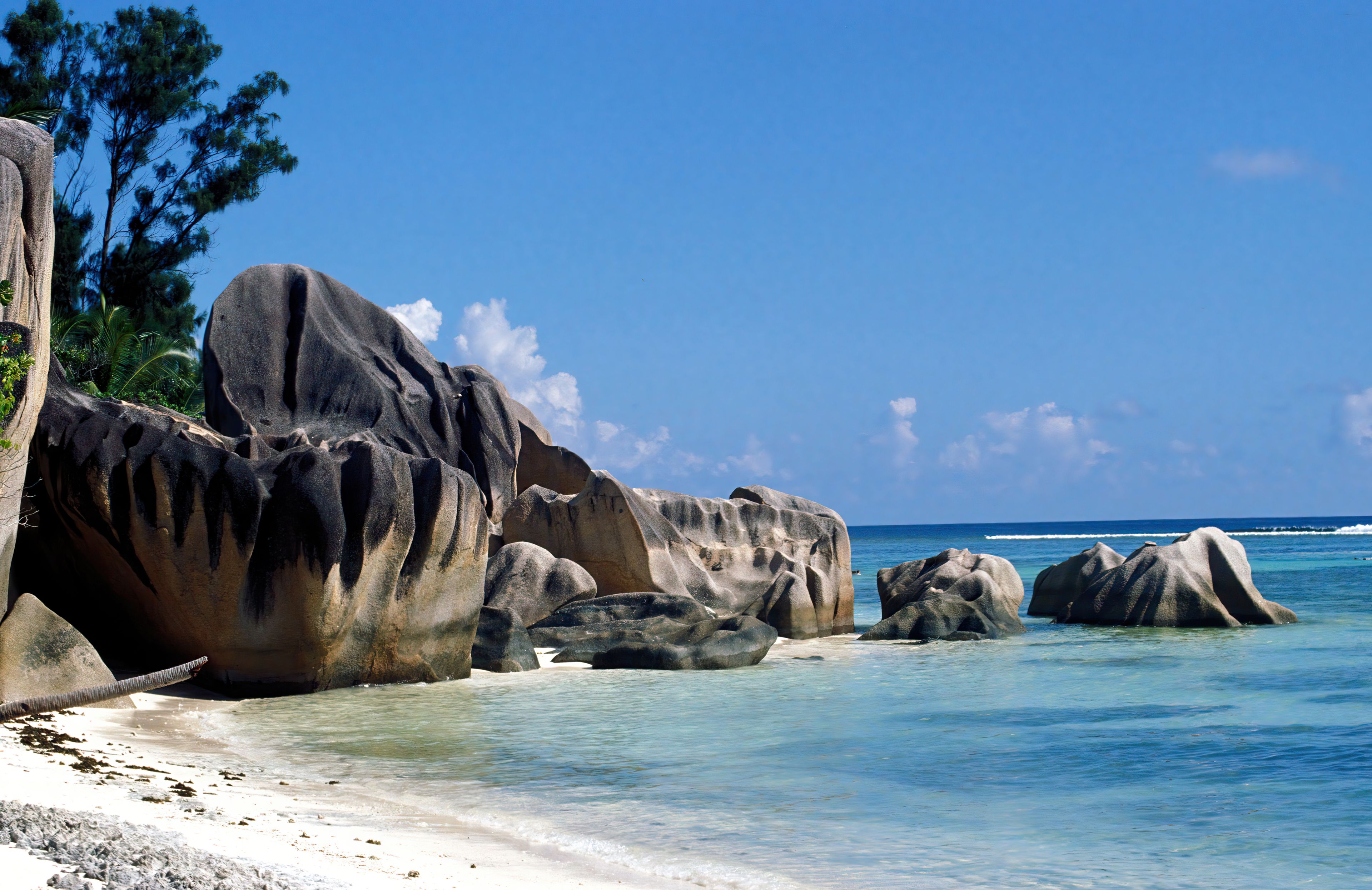
Anse Source d’Argent
Step past the postcard boulders and you enter a living corridor of saltwater mirrors and soft light.
Anse Source d’Argent is photographed like a monument, but it’s experienced like a tide-driven room—granite walls, shallow water, and light that keeps changing its mind.
Most people stop at the famous boulders and the first lagoon. The real narrative runs behind them: a narrow chain of tide pools and channels that quietly rearrange the beach every hour.
When you follow that corridor, the beach stops being a backdrop. It becomes intimate—ankle-deep, salt-sweet, and so finely detailed you find yourself moving slower on purpose.
The beach has a backstage—follow the tide pools, not the crowd
The most famous view at Anse Source d’Argent teaches people to look outward—wide angle, big boulders, perfect horizon. The place’s real craft is quieter and closer. Behind the best-known granite clusters, the shoreline breaks into a tide pool corridor: shallow basins connected by narrow runnels that pulse as the ocean breathes. At low to mid tide, you can wade from pocket to pocket, each one a different micro-scene—glass water trapped over pale sand, greenish pools tinted by seagrass fragments, and darker bowls where the granite casts a cool, bluish shade. What you’re watching is time made visible. The waterline shifts by meters, not inches. A channel that’s a calm ankle-deep walkway becomes knee-deep and lively in an hour, tugging at your calves and carrying tiny bubbles like a string of pearls. The granite, so photogenic from a distance, is even more compelling up close: salt-polished curves, rough crystalline patches, and seams that collect a thin ribbon of sand. If you slow down, you notice how the beach edits itself—sand migrating, shells sorting, sea foam sketching temporary borders. This corridor changes the feeling of the whole beach. Instead of competing for a single viewpoint, you start composing your own small frames. It’s less “iconic” and more personal… and that’s the version you remember on the flight home.
You arrive with the sound of bicycles and distant surf in your ears, then the path funnels you through palms and takamaka into sudden brightness. Granite rises in sculpted slabs—warm, grainy, streaked with rust and lichen—casting shade like stage wings. You step off sand into water that barely covers your ankles, and it’s cooler than you expect, a thin sheet sliding over rock-smooth basins. Each pool holds its own color: tea-gold where the sand is stirred, pale jade where it’s clean, and a quicksilver sheen where the sun hits at a low angle. You move behind the headline boulders and the beach narrows into a sequence of little rooms… a channel you can wade, a pocket of sand rimmed by coral rubble, a silent bowl where the only noise is your breath and the click of tiny shells underfoot. When a breeze arrives, it combs the surface into ripples and the whole corridor starts to glitter, as if someone turned up the contrast.
The Water
The water reads like layered glass: clear over white sand, then a soft pistachio tint where depth gathers between rocks. In shade it turns silvery-blue, and in sun it flashes with a metallic sheen across the ripples.
The Cliffs
These are ancient granite formations—rounded, split, and stacked like sculpture—set against a low fringe of palms and takamaka. Coral fragments and fine sand collect in pockets, creating natural basins that trap seawater as the tide retreats.
The Light
Late afternoon brings the most dimensional light: long shadows that carve the granite into relief and warm tones that turn the rocks honeyed. Early morning is cleaner and quieter, with cooler whites in the sand and a calmer surface for reflections.
Best Angles
Behind-the-boulders tide pool chain
You get repeating ‘rooms’ of granite and water—ideal for layered compositions that feel intimate, not postcard-wide.
Granite arching slabs at mid-beach
Shoot low along the curve of the rock to emphasize scale and texture; the waterline becomes a leading line.
Channel crossing toward the outer shallows
This angle catches movement—ripples, eddies, and the tide’s flow—so your images feel alive rather than static.
Reflection pool in deep shade
For photographers: use the darker basin as a mirror for granite silhouettes and palms; it holds detail even in bright conditions.
Sand pocket between two boulder ‘walls’
The tight frame removes the crowd and horizon, giving you a private, tactile portrait of the beach.
Check tide times for La Digue and aim for low to mid tide if you want the full tide pool corridor.
Bring reef shoes or sturdy sandals—the granite can be slick and coral rubble can be sharp in the shallows.
Carry small cash for L’Union Estate entry and a little extra for a cold drink on the way back.
Pack water and a light layer of sun protection; the shade shifts and you can end up exposed longer than you plan.
If you want cleaner photos, walk past the first main lagoon and keep going behind the boulders—crowds thin quickly once you commit to exploring.
Handpicked Stays & Tables
Places chosen for beauty and intention, not algorithms. Each one is worth your time.

Le Domaine de L’Orangeraie Resort & Spa
La Digue (near Anse Severe / La Passe)
A polished, foliage-wrapped resort where you can slip from pool to bicycle to beach without friction. The villas feel cocooned, and the spa is a credible reason to plan your days around late-afternoon light.

Le Nautique Luxury Waterfront Hotel
La Passe waterfront, La Digue
Small, calm, and pointed toward the water—ideal if you like mornings that start with a quiet shoreline and end with dinner steps from your room. Service feels personal without being performative.

Lanbousir
La Digue (near L’Union Estate / Anse Source d’Argent area)
Creole cooking with the island’s rhythm—grilled fish, curries, and the kind of sauces that make you slow down. Come hungry and let lunch stretch, especially after a long wade through the pools.

Fish Trap Restaurant
La Passe, La Digue
A dependable, sea-facing choice for fresh catch and well-handled Creole classics. It suits a post-beach reset: clean flavors, a soft breeze, and a view that keeps you in the mood of the island.
Past the famous granite, the shoreline becomes a sequence of small, tide-lit rooms—and you leave feeling like you actually met the place.