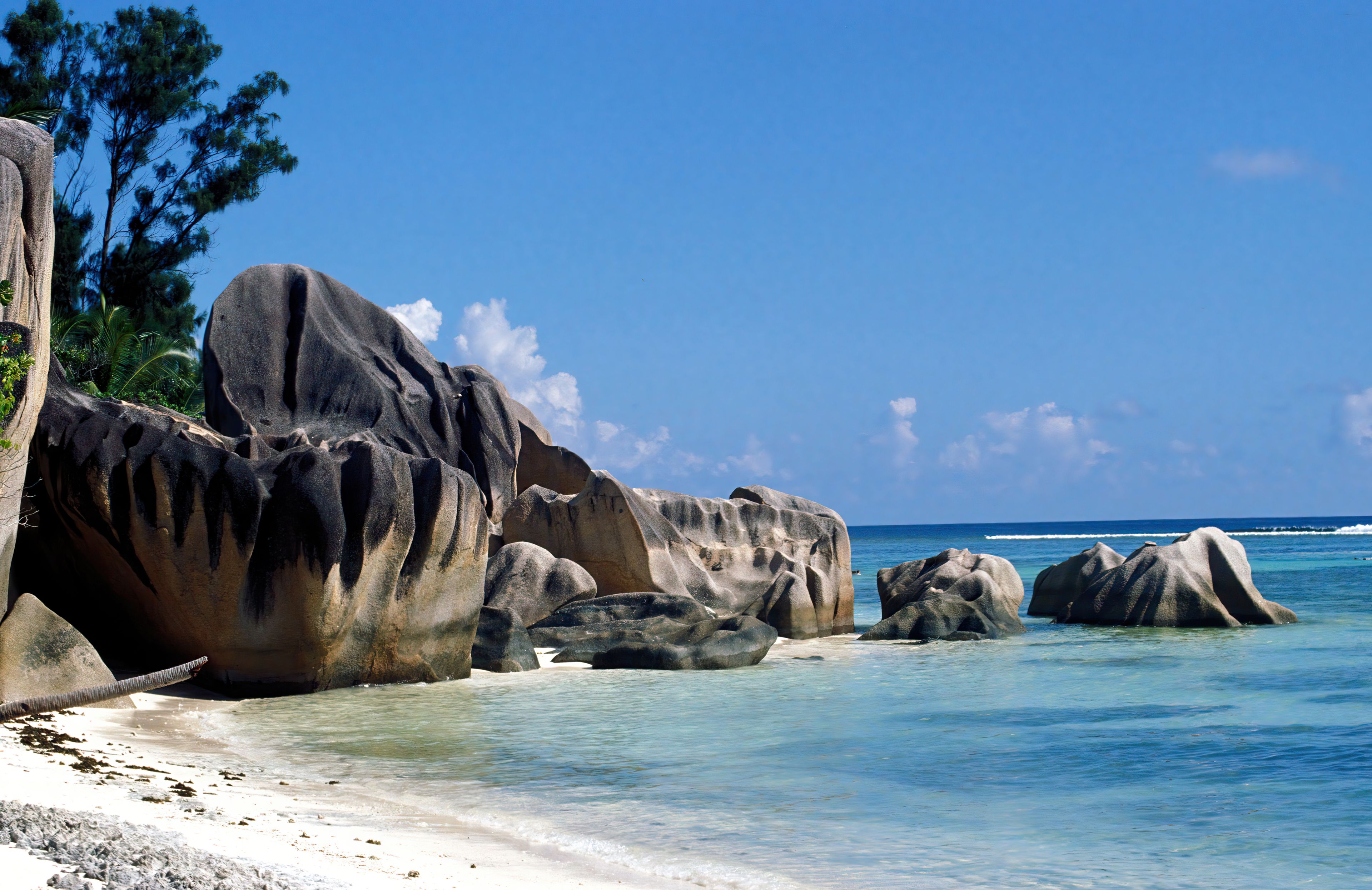
Anse Source d’Argent
At Anse Source d’Argent, the real masterpiece is in the granite—if you slow down enough to read it.
You arrive expecting a photograph you already know: pale sand, turquoise water, and those sculpted granite boulders posed like a set. But standing here on La Digue, the scene feels less like a postcard and more like a living gallery—salt in the air, palms clicking softly above you, water breathing in and out through the rocks.
Most people look at the boulders as props. Look closer and they turn into documents—pink veins, peppered crystals, dark seams, and weathered skins that tell you exactly how time moves on a tropical coast: slowly, insistently, and in layers.
Once you stop chasing the “iconic shot,” the beach starts giving you something rarer: a sense of intimacy with scale. You feel small, not in a powerless way—more like you’ve been allowed into a quiet, ancient conversation.
The Granite Isn’t Gray—It’s Blushing, Layered, and Alive
Anse Source d’Argent gets described as “granite and turquoise,” as if the rocks are neutral backdrops. They aren’t. Up close, the boulders carry a delicate color story—warm pink undertones, milky quartz seams, and darker mineral freckles that look like someone dusted the surface with pepper. Those pink veins aren’t decorative; they’re your clue that these stones are old, slow-cooked under pressure, and then patiently sculpted by salt, rain, and the daily pull of tide. Most visitors stand at a single opening between rocks, point the camera outward, and leave with the same image as everyone else. Instead, walk toward the boulders as if you’re entering architecture. Notice how the sand cools in the shade, how the air smells slightly metallic near wet stone, how each curved face channels wind and amplifies the soft percussion of wavelets. In the narrow passages, you can feel the beach become private—even when there are people nearby. If you time it with a gentle tide, the lagoon turns into a lens. Water pools at the base of the granite and reflects those pink notes back into the scene, so the whole shoreline looks warmer, more human. It’s less about “the view” and more about the way the place teaches you to see.
You step through L’Union Estate as the day warms—dusty path underfoot, a faint sweetness from vanilla and drying coconut, the low clink of tools somewhere behind a wall of palms. The light changes as you near the shore, sharpening from garden-green to a bright, salt-white glare. Then the granite appears, not as a single formation but as a procession of bodies—rounded backs, narrow corridors, overhangs that hold shadow like cool water. You walk into one of those corridors and the sound shifts: wind drops away, waves become a muffled pulse, and your own footsteps land softly on sand that feels sifted, almost flour-fine. The lagoon is clear enough to read—pale aquamarine over sand, deepening to jade where sea grass darkens the bottom. When a cloud passes, the boulders blush; when sun returns, quartz flecks spark like a shaken glass of sugar. You wade in, ankle-deep, and the water is warm but never lazy… it keeps moving, threading itself between stone and shore.
The Water
The lagoon reads in layers: glass-clear shallows that tint pale aquamarine over sand, then a greener jade where sea grass gathers. In bright sun, it can look almost luminous; under cloud, it turns silky and subdued, like brushed glass.
The Cliffs
This is a granite coastline in miniature theaters—rounded boulders stacked and folded into corridors, alcoves, and framed windows to the sea. Behind the sand, palms and takamaka trees soften the edges, but the dominant feeling is stone: weight, curvature, and time made visible.
The Light
Early morning gives you clean, directional light that picks out the boulders’ textures—every vein and crystal shows. Late afternoon warms the granite into blush tones and stretches shadows into the gaps, making the beach feel more sculptural and less crowded in your frame.
Best Angles
The classic granite corridor (central beach openings)
It gives you that signature frame—sand leading line, boulders as wings, lagoon as a calm stage—without needing a wide lens to feel expansive.
Shaded boulder undercuts at the waterline
Crouch low and shoot along the wet sand; reflections pull pink tones into the scene and the stone feels monumental rather than decorative.
The palm edge above the sand (tree-line perspective)
Step back into the greenery and let fronds partially veil the view; it adds depth, scale, and a sense of arrival rather than a static “beach shot.”
Tide pools between boulders (after a small swell)
For photographers, this is where the granite’s veins and quartz sparkle show best—use the pool as a mirror and focus on texture over horizon.
Narrow passageways between stacked rocks
The intimate angle: shoot through the gap so the beach becomes a secret room—faces disappear, sound feels closer, and the place turns personal.
Bring cash or a card for L’Union Estate entry and allow time for the walk—this beach is earned in minutes, not steps.
Wear water shoes if you plan to explore around rocks; some granite edges and coral fragments can be sharp under a thin tide.
Pack reef-safe sunscreen and a light cover-up—shade exists, but it’s patchy once you move away from the tree line.
If you’re photographing, carry a cloth for lens wipes; salt mist and humidity fog glass quickly in the boulder corridors.
Respect the formations: don’t climb on delicate edges for shots, and watch for incoming sets that can surge through narrow gaps.
Handpicked Stays & Tables
Places chosen for beauty and intention, not algorithms. Each one is worth your time.

Le Domaine de L’Orangeraie
La Digue (near La Passe)
A polished, design-forward base with villas set in lush hillside greens and an easy run to the island’s beaches. After a salt-and-sun day, the spa and quiet pool areas feel like a soft landing.

La Digue Island Lodge
La Passe beachfront
Classic island ease with direct beach access and a setting that keeps you close to ferry logistics without feeling rushed. It’s practical in the best way—comfortable, breezy, and made for early starts.

Fish Trap Restaurant (Le Domaine de L’Orangeraie)
La Digue (near Anse Severe/La Passe)
Seafood-led plates in a refined setting that still feels island-casual. Come at dusk when the air cools and the day’s salt gives way to candlelight and quieter conversation.

Rey & Josh Cafe Takeaway
La Passe, La Digue
A relaxed, local favorite for straightforward Creole flavors and takeaway that travels well. Ideal for assembling a beach picnic before you walk through L’Union Estate.
When you leave, it isn’t the turquoise that follows you—it’s the blush of granite in the shade, and the patience it teaches you.