Abraham Lake
When the wind writes its name in ice.
Abraham Lake is a long, spare stretch of water held between road and peaks.
In winter it stops behaving like a lake and starts behaving like weather—ice, wind, and light in constant negotiation.
It matters because it teaches you to look down, not out, and to feel time in small changes.
The Ice Ridges Between the Bubble Fields
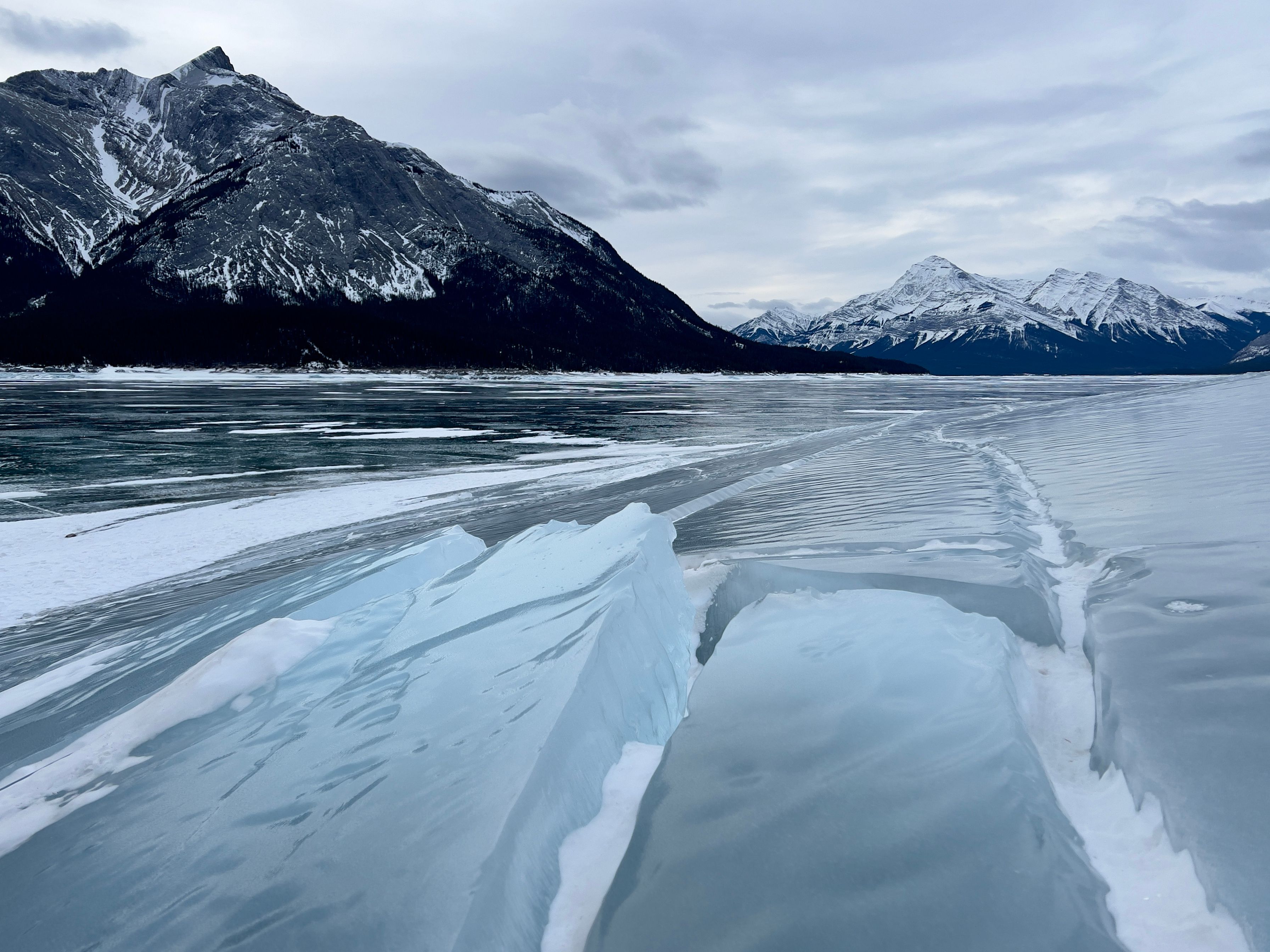
Most people arrive for the frozen methane bubbles—those clean, stacked coins in the ice—and they walk fast, scanning for the next clear patch. Under their boots are the ridges: low, wind-sculpted folds where the ice has been pushed, dried, re-frozen, then sanded smooth again. They look like nothing until you stop and let your eyes adjust to shallow relief. On Abraham, wind is the real shoreline. It combs the surface into pale seams and darker plates, leaving thin lines of snow like chalk in the grooves. Sometimes the ridges run in parallel bands; sometimes they knot and overlap, where a thaw softened the skin and a hard night tightened it again. If you crouch, you’ll see trapped grit and tiny air needles along the crest—evidence of a day when the lake was loud with gusts. The bubbles are the headline. The ridges are the handwriting.
The Hour After the Wind Drops
Abraham changes when the wind finally pauses—often in late afternoon or just after dusk, when the valley cools and the gusts lose their edge. The lake has spent the day scouring itself: snow pushed into thin veils, exposed ice polished to a dull shine, ridges sharpened and then softened again by drifting powder. In the first quiet hour, everything becomes legible. The ridges stop flashing with moving snow and settle into a steady pattern, like corduroy laid across the surface. The bubble fields, usually the brightest feature, begin to feel secondary as the low sun skims the ice and turns the raised seams into long, faint shadows. You can hear small sounds then—your jacket, a distant truck on the Icefields Parkway, the tiny tick of cooling ice. It’s not dramatic. It’s simply the lake becoming still enough to read.
The Reflections
In winter, reflections aren’t on water—they’re trapped in the ice’s sheen, a muted mirror that holds the mountains in broken panels. After a windless spell, the smooth plates reflect the sky in soft gradients, interrupted by ridges like thin horizons.
The Water
When open water appears (often shoulder season), the lake reads as cold jade to steel-blue, colored by glacial silt from the North Saskatchewan River. In deep winter, that color shifts into the ice itself—milky aqua where snow has fused, clear glass where wind has stripped it clean.
The Landscape
The lake sits in a wide corridor of the Rockies: low, tawny slopes near the road and higher, darker faces further back. The setting feels stripped down—big sky, exposed ice, and mountains that seem to watch rather than perform.
Best Angles
Preacher’s Point pullouts (north side, along AB-11)
Stand at the lake edge and frame low: ridges in the foreground leading toward the distant peaks. Shoot slightly oblique to the wind lines so the texture shows as shadow, not flat shine.
Wind-swept bays near the Cline River area
Walk out only as far as you feel confident and keep the horizon high; let the ice do most of the work. This area often has alternating clear plates and powdered seams that read like brushed metal.
Between bubble clusters, not on them
Most creators center the bubbles; instead, compose where the ridges thread around the clear pockets. Look for a single ridge crest that catches light and use it as a leading line.
Crouched, close to the surface
Turn away from the mountains for one minute. Photograph the ridge edge, grit lines, and tiny air needles—an intimate record of the day’s wind rather than the landscape.
Crowd pattern — Weekends in February draw bubble-chasers mid-day; weekday mornings are often quiet, especially in colder snaps.
Effort level — Mostly short walks from pullouts, but expect uneven snow, hard ice, and constant wind chill; the lake can feel physically tiring even without distance.
Access note — No entry gate for the lake itself; conditions are uncontrolled. Treat the ice as alpine terrain and check local advisories when possible.
What to bring — Windproof outer layer, ice cleats, warm gloves that still allow you to operate a camera/phone, and a thermos (there’s little shelter once you step off the road).
Handpicked Stays & Tables
Places chosen for beauty and intention, not algorithms. Each one is worth your time.

Aurora Borealis Lodge
Nordegg, Alberta

The Crimson Jasper
Jasper, Alberta

Miners Cafe
Nordegg, Alberta

The Brick Eatery
Jasper, Alberta
On Abraham, the most honest scenery is the part you nearly step past.